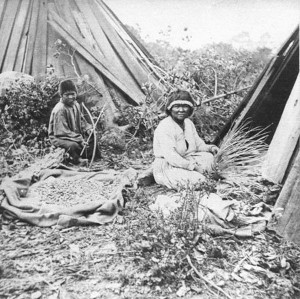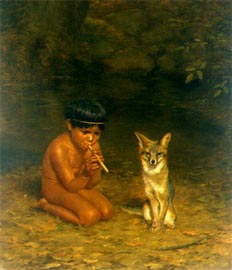
If asked what California was called before Europeans “discovered” it, a 16th century Indian might well have said, “Ours!” Prior to any Euro-Americans, there were indigenous people living in present day California for an estimated 10 to 15,000 years. By the 16th century, they comprised about 300,000 people, speaking more than 60 languages (Fagan,.4). Although the early explorers and missionaries recorded some of their encounters with the indigenous people of California, their observations were generally buried in dusty volumes thumbed by historians centuries later. Only since the second half of the 19th century did the “new” Californians begin to learn about the indigenous people they called Indians. The earliest studies were simple word lists as a process of communication and trade began. Later would follow more systematic information on tribes—a somewhat simplistic designation for people, generally preliterate, who appear to share the same language, kinship, and culture.
Among the so-called “north coastal tribes,” the Pomo, the Coast Yuki, and the Coast Miwok are the ones most likely to have walked within MRC forests, although there was always an interconnectedness between indigenous human populations and their neighbors for food, ornaments, and tools. While the footprints of the indigenous people have disappeared, some of their trails, as well as village sites with scattered points and pottery shards, still remain on the forest floor. Such evidence is scarcely visible, though, except to the trained eye. In Before California, Brian Fagan writes of how difficult it is for even the “experts” to interpret this past.