03) Big River

The face of the river, in time, became a wonderful book . . .which told its mind to me without reserve, delivering its most cherished secrets as clearly as if it had uttered them with a voice. And it was not a book to be read once and thrown aside, for it had a new story to tell every day.
Mark Twain (1835-1910)

Overview

Compared to Mark Twain’s mighty Mississippi, Big River is not big at all. The Big River watershed is about 181 square miles; the Mississippi’s, 1.2 million square miles. Mark Twain knew, however, that a river, especially in 19th century America, was more than just meandering water. Its social impact could not be measured in river miles or watershed size. A river was a wild stream of dreams and destinies, of stories waiting to unfold. For the logging pioneers of Mendocino County, Big River became their dream and their destiny—the entrance to the forest by the sea. With the help of Big River, these individuals pitted themselves against both the forest giants and the treacherous sea. They tackled the earth’s biggest trees with only hand axes and saws, often taking a week or more to fell one tree. Oxen, yoked together in teams of eight or twelve, dragged the immense logs to the river’s edge, where they were collected behind splash dams, and then floated downstream to a sawmill. From there the cut lumber was loaded onto schooners lying just off the jagged Mendocino coast. The primeval forest, that must have seemed at first so impregnable, stretching out further than eye could see or eagle could fly, fell one tree at a time to human determination. Only individual old growth trees or groves, too inaccessible for the early technology or judged undesirable for milling, remain—scattered about the shadowlands, lonely reminders of a giant forest that once touched the sea.

The pioneer lumbermen of Mendocino County never heard of “the American Dream.” That term was coined by an American historian, James Adams, in 1931, ironically during the Great Depression when many Americans, out of work and out of luck, thought the dream had died. The Big River lumbermen, however, embodied the very essence of the American dream, namely, that with hard work, determination, and audacity, anyone could achieve wealth. Wealth represented freedom—freedom from want, freedom to have more, freedom from the past. Like the immigrants before them, they were part of an inexorable push of Americans to expand, to tame, to build, and to succeed.

Men like Jerome Ford and Edwards Williams, the entrepreneurs or adventurers who started logging operations at Big River, as well as all those who came after them in Mendocino County for the next 100 years, were so successful that they almost destroyed what they first admired. The National Park Service estimates that about 3% of the ancient redwood forest remains, while most coastal redwoods, except for those in state and national parks, are second and third growth. “Why did they take it all?” That question nags many of us. One answer is that the early lumbermen in northern California could not have known how old the redwood trees were that their sweat and ingenuity toppled. Archaeological tree-ring dating started about 1917 with the work of an astronomer, Andrew Douglass, although the practice took several decades to be widespread. Before that, we were dependent on human memory. In the 19th century, a Philadelphia merchant might point to a spreading oak tree in the court house square and say, “Son, your grandfather told me this tree was here when the Declaration of Independence was signed in 1776.” Jerome Ford arrived at Big River to lay plans for the first sawmill in Mendocino County on June 16, 1852—just 76 years after the signing of the Declaration of Independence. How could he know that the trees he stared at in disbelief were 500, 1500, or even more than 2000 years old? Even with the help of science, our minds have difficulty comprehending the life span of an ancient redwood. Would the loggers have stayed the swing of their axes if they had known the age of the redwood forest? Not likely, any more than they would have stayed their picks to let the gold lie quietly beneath the earth. Today there are many get-rich dreams to latch onto, including the workingman’s favorite—winning the lottery. In the 19th century, the land and its resources were the ready means to wealth.

We also cannot ignore the fact that, while there were individuals in the early 19th century who wrote about the beauties of nature, there was not a general environmental consciousness. George Stewart, often called the Father of Sequoia National Park, wrote editorials as early as 1876 about the destruction of the giant sequoias, trees in the same botanical family as the coastal redwoods. As a result, the U.S. government created Sequoia, Yosemite, and General Grant national parks in 1890. John Muir matured his conservation philosophy while working in Yosemite Valley from 1869-1871. Muir, in fact, operated a small sawmill near Yosemite Falls to lumber wind-felled trees. Not until 1892, however, did he become one of the founding members of the Sierra Club to save America’s last wilderness. Around 1903, the Sempervirens Club managed to acquire 3800 acres of coastal redwoods at Big Basin near Santa Cruz, California and have the area declared a park. As the influence of such groups grew and environmental concerns became a movement, more pressure was put on government agencies and lumber companies to act responsibly about the remaining redwood old growth, but by then America was well into the 20th century and most of the old growth redwood was depleted.

Deforestation, as reports from the U.N. and environmental watch groups remind us, is a global issue. This was also true in 19th century America. In his book, A Forest Journey, John Perlin observes that “forests always recede as civilizations develop and grow.” For over 5,000 years, wood was the primary material for housing, fuel, furniture, ships, bridges, carriages, wagons, carts, mine shafts, waterwheels, spears, tool handles, wine barrels—the list goes on and on. As their own forests receded, England and Europe looked to the “New World” to supply their need for wood. In the 19th century, while we were shipping lumber to England, West Indies, and other places, Americans placed their own considerable pressures on our forests as our population rapidly grew. According to the U.S. Census Bureau, there were about 3.9 million people in U.S. states and territories in 1790; 7.2 million in 1810; 23.1 million in 1850; and 50.1 in 1880. Many Americans saw the forest as standing in the way of houses, villages, and agriculture. Their goal was not saving or managing a forest but pushing it further and further back. Tench Coxe, an early American economist and associate of Alexander Hamilton, wrote in the preface to the 1810 U.S. census that “our forests [en]cumber a rich soil, a hundred or two hundred miles from the sea, and prevent its cultivation” (Perlin, 360). He advised Americans to reduce the forests to cabinets, furniture, gun stocks, casks, shingles, charcoal, and fuel. The forests east of the Mississippi and north of the Ohio were the first to recede. Frederick Marryat, a 19th century English novelist, observed in his travels of upstate New York that “the giants of the forest, which had for so many centuries reared their heads undisturbed…now lay prostrate before civilization” (Perlin, 356). In early America, it was not simply the redwoods that grew to large size. Perlin cites reports from the early 1800s of oak that was over 140 ft high and 6 ft in diameter, walnut trees 7 ft in diameter, and sycamore almost 13 feet in diameter (Perlin, 325-6).. The Eastern states had supplied high-priced lumber to San Francisco merchants as population and construction exploded there following the Gold Rush. The discovery of the redwood forests of northern California opened a new, less expensive supply of wood for Californians.

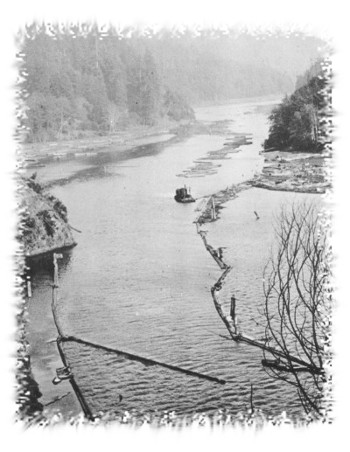
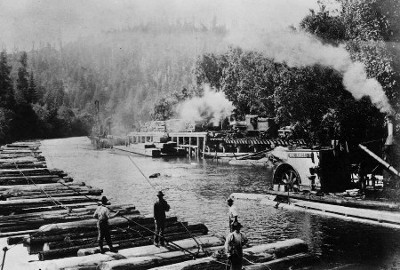
Today Mendocino Redwood Company owns about 30% of the Big River watershed, near its headwaters. This amounts to 34,114 acres of which less than 500 acres have scattered old growth trees. The next largest owner of the Big River watershed is Jackson Demonstration State Forest with 22,714 acres. The top photo shows Big River snaking toward the sea, the ocean breakers pushing back its spillage. The first sawmill in Mendocino County was built on the Mendocino headlands, rising about 95 ft above the ocean—the site just visible in the bottom center of the photo. A later saw mill was built on the river flats, not far from the mouth of the river. This photo was digitally manipulated to show how Big River might have looked to the early lumbermen. Mouse over the photo to see a more recent view. The bottom photo is a picture of the steamer, “Big River,” towing log rafts.

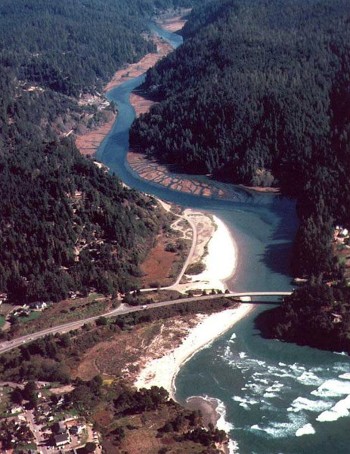
Photo Credits:
Aerial color photo off Mendocino Headlands courtesy of California State Parks.
Big River from Robert J. Lee Collection (Ukiah).
Secondary Sources:
Big River Watershed: Sediment Analysis Report, Graham Matthews and Associates (July 2001).
Perlin, John. A Forest Journey: The Role of Wood in the Development of Civilization. New York: W.W. Norton, 1989.

The Wreck of the Frolic

Ironically, the story of redwood logging in Mendocino County begins not on land but on sea! It has all the elements of a good modern tale—foreign lands, clashing ambitions, drug deals, even life-and-death struggles.

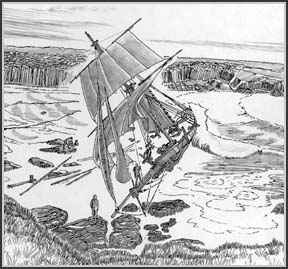
Ever since her Baltimore launching in 1844, the Frolic had made her reputation and her profits as an opium clipper between China and India. By 1850 she was no longer a proud ship nor a profitable investment. Just a year earlier, she had weathered a typhoon enroute to Shanghai. Only one day out to sea, the crippled Frolic had to be towed to Hong Kong where storm damage and dry rot were repaired. Three months later she sailed to Bombay to pick up one last cargo of opium, returning to China on May 21, 1850. By then it was clear to one of her owners, John Heard, that the Frolic had finally been outrun by time and the new steamships that were plying the opium sea routes.

While the Frolic had lost her competitive edge in the opium market, Heard believed she could still bring a good price in California, where she could make short runs up and down the coast. He was planning to sell her there if everything went well on her last voyage from the China seas. Later, as it happened, Heard would reconsider. The California Gold Rush had created a new consumer frenzy as thousands made their way to the land of gold and dreams. Even as the Frolic’s cargo was being assembled in Hong Kong, Heard learned that his profits on an earlier consignment to California via the Eveline was at least 75% on every item and, in some cases, upwards of 200%. Writing to his uncle Augustine, the head of the firm, John Heard said that if all went went well on this California sailing, it might be in their “interest” to keep the Frolic for this “line of business”.

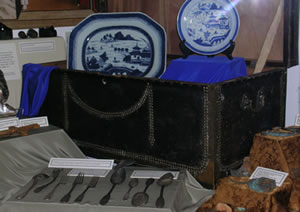
On June 10, 1850, the Frolic left Hong Kong bound for San Francisco. This time her cargo consisted of Chinese silks, porcelains, and paintings; silverware; camphor trunks; Edinburgh ale; ivory fans; jewelry; game boards; combs; umbrellas; and other goods for eager California shoppers. At her helm was a 43-year-old captain that had sailed her since her maiden voyage—Edward Horatio Faucon. While still a young man, Faucon had been immortalized as the “good captain” by Richard Dana in his 1840 memoir Two Years before the Mast.

After an uneventful trip of 6 weeks and 6000 miles, Faucon was within 100 miles of San Francisco. It was a seemingly clear moon-drenched night. About 9:30 pm on July 25, the first officer spotted breakers up ahead. Faucon’s first reaction was “It’s impossible.” There wasn’t time for a second thought. The Frolic struck a large rock about a half mile north of Point Cabrillo. Her rudder snapped, her hulled cracked, and she began to take on water. Faucon gave the order to lower two lifeboats.

Six crewmen remained on board the Frolic, apparently clinging throughout the night to her rigging. Faucon headed further down the coast with the two boats and the remainder of the crew. By daylight, Faucon and his men had reached a beach about six miles south of the wreckage near the mouth of Big River. Faucon decided to hike inland looking for Indians that might be able to help him and his men. When he found no one, he returned to the beach. Most of the crew decided to take their chances on land. Their decision might have been prompted by the fact that one of the lifeboats had begun to leak.

With two officers, four oarsmen, and a sick Hindi sailor, Faucon guided the sturdier boat south, closely following the coastline. By August 4, he and his crew reached San Francisco. Not unlike today, he was promptly intercepted by a reporter and interviewed.The next day, the local newspaper ran a story about the wreck, including estimates of the lost cargo. In the following spring of 1851, Henry Meiggs. a wealthy, fast-dealing entrepreneur, sent Jerome Ford, the superintendent of his sawmill in Bodega Bay, to look for the Frolic. Meiggs was interested in whether the Frolic’s cargo could be salvaged. By the time Ford got to the location of the wreck, there was nothing left. Between Frolic’s survivors and the Pomo Indians, all the debris had been picked from the surf and beach.

A former Vermont woodsman, Ford looked around and spotted something a lot more valuable than salvage—towering redwood trees. Upon his return to San Francisco, Ford told Meiggs about his find. After Meiggs listened to Ford’s reports of giant trees and money to be made, he ordered a “sawmill” from back East and then bought a ship, the Ontario, to sail the ready-made mill up north. With Ford’s help, Meiggs established the first sawmill on the northern California coast at the Mendocino Headlands in 1852. Apparently Ford purchased the land from William Kasten, who had already claimed squatter’s rights .In some accounts, Kasten, a German immigrant, had been a survivor of the Frolic. Rather than ending up in the California gold fields, he became one of the original settlers of Mendocino.

Image Credit
Illustration of Frolic by S. F. Manning.
Secondary Source
Layton, Thomas N. The Voyage of the Frolic, Stanford University Press, 1997.
The Mendocino County Museum in Willits, CA has been designated the official depository for Frolic artifacts by the California Legislature.

First Mendocino Sawmill

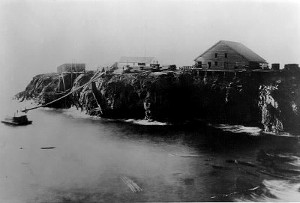
The first sawmill in Mendocino County, which appears as the large barn-like building in the photograph on the left, was built on the Mendocino Headlands for Henry Meiggs as part of the California Lumber Manufacturing Company, incorporated June 20, 1852. Meiggs was a colorful San Francisco businessman, regarded by some as an entrepreneur and others as a hustler. Meiggs sent Jerome Ford to scout a location for a new mill, while E. C. Williams, a veteran of the Mexican War and friend of Kit Carson, sailed from the East Coast on the Ontario with the mill itself, the mill machinery, and 40 mechanics and laborers to put it all together. David Ryder, who wrote the history of Union Lumber Company (a company that would purchase these early Mendocino timberlands in 1906), reconstructed Ford’s journey from very brief entries in Ford’s diary.

Ford took the boat from San Francisco to Benicia, and went from there to Napa, and then to Sonoma by stage. At Sonoma he remained long enough to buy or hire three saddle horses and two pack mules. Also to witness a fight in which one of the adversaries pulled a gun and shot half the other man’s teeth out without killing him. Ford then rode to Bodega Corners and stayed a day or two with Captain Smith; buying eight yoke of oxen, and hiring two men to help him with the mules and oxen. From there the party proceeded up the Coast by slow stages, camping wherever night overtook them. There were no roads—only rough, narrow trails—and they had to swim the swollen rivers. Crossing one of them—probably the Gualala, boundary between Mendocino and Sonoma counties—one mule drowned and the other swam downstream, got ashore and ran away. This was a real calamity, for, besides losing the mules, the party lost all its provisions and blankets. Thereafter they had only saddle blankets—”sweat cloths” Ford calls them—to sleep under, and for thirty-six hours they had nothing to eat but some berries they gathered along the trail. Then they reached what Ford referred to as “The Portuguese Ranch,” near the Navarro River, and there got their first square meal in nearly two days, replenished their provisions, and rested for two days. Finally after ten days of hard, slow travel, they reached the mouth of the Big River, which Ford alternately called the “Rio Grande” and the “Bull Don.” The former name was the one used by the Spanish and the latter his own version of the Indian name, “Booldam,” which likewise meant “large stream. (Ryder, 53)

Ford finally arrived at Big River on June 16, 1852 and E. C. Williams one month later on July 19th. In a reminiscence that Williams, in his 80s, wrote for the Pioneer Western Lumberman in 1912, he recalls the early days.

The difficulties connected with the building of the mill were many and great. Our millwright proved wholly incompetent; men became dissatisfied and left at a moment’s warning, and their places could only be filled by our sending to San Francisco and bringing men overland up the Coast. Before the mill had its roof on, the storms began; and for years the memory of that winter came to me as a horrible nightmare. But Spring came at last and the mill was finished, and we began shipping its output to market at the rate of 50,000 feet a day. (Ryder, 56)

The 50,000 feet of lumber that Williams refers to would fill about one railcar or two truck and trailer loads.

With Henry Meiggs heavily in debt, the California Lumber Manufacturing Company suspended operations on October 10, 1854. The private banking firm of Godeffroy and Sillem filed a lien against the mill for debts owed, as did Jerome Ford and E.C. Williams as well. Ford, Williams, and the banking firm would resurrect operations in Spring 1855 with a second mill on the Big River flats. The name of the company was the Mendocino Saw Mills. Ford in a letter of 1865 remarks that the mill is now producing about 15 million feet of lumber a year and bringing in $250,000 in sales (Bear, 2) Eventually Ford and Williams managed to pay off both Meiggs’ creditors and Godeffroy and Sillem, becoming the sole owners of the sawmills. Jerome Ford moved to Oakland in 1872 and his son, Chester, took over the Ford interests in the company. E.C. Williams and Chester Ford became partners in the re-christened Mendocino Lumber Company. In 1902 Chester Ford sold his share in the company to Captain Asa Simpson. Williams and Simpson remained the owners of Mendocino Lumber Company until its sale to Union Lumber Company in 1906. David Ryder summarizes the importance of the Mendocino saw mill in its various iterations:

It was lumber from the Mendocino Saw Mills (later re-named the Mendocino Lumber Company), that helped materially to rebuild San Francisco after its many conflagrations in the [1850s]. It was the Mendocino Saw Mills that had what is claimed to have been the first railroad in California—a mile of track over which oxen pulled carloads of lumber from the mill up to the chute on the Point. It was the Mendocino Saw Mills that provided the first cargoes of lumber for the little two-masted schooners which became so much a part of the life and the history of the Mendocino Coast. And it was the Mendocino Saw Mills that founded the town of Mendocino and made it for years the most important shipping center and community on the whole Mendocino Coast. (Ryder, 57)

Ryder’s summary mentions chutes and lumber schooners. Those, like Henry Meiggs, who were part of the pioneer timber industry in northern California needed a fast and efficient way to get lumber to San Francisco. There were no accessible roads, no railroads. Transportation had to be by sea. Meiggs built his sawmill on a promontory, called today the Mendocino Headlands. The problem Meiggs and others faced was, first, how to get a ship close to the coastline and, second, how to load lumber from a bluff— 75 ft or more high—to a ship below that at any moment could be carried by wind or sea swells onto jagged rocks or out to sea. This was dangerous, even life threatening, business. There were no harbors in Mendocino County, no breakwaters, no wharves—no such thing as “safe anchorage.” In fact, the coast at Meiggs sawmill was nothing more than a shallow cove, often called a doghole because there was only room, the seamen said, for a dog to turn around and lie down.

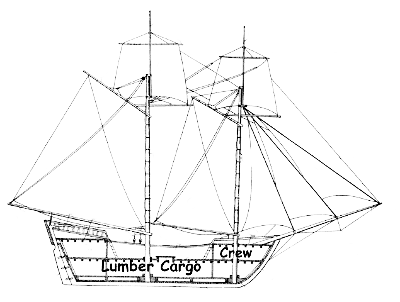
The first part of the solution to the problem came from the design of the ship itself. The early Mendocino timber men used schooners that were shallow drafted, sitting high in the water and moving more surely over the submerged reefs. Because of the narrowness of the hull, however, cargo space was limited.The second part of the solution was to use an “apron chute” or adjustable slide to lower the lumber onto the deck of a ship. This technique is shown in the rare photograph above. Workers on the bluff slid the lumber, piece by piece, down to deck hands who “caught,” packed, and lashed the lumber on the schooner .Sometimes the lumber was slid to a lighter, similar to a log raft, and then transferred to the ship (Jackson, 141). Around 1900, wire and steel cable was used to transfer a large load of lumber onto a ship in one swing.

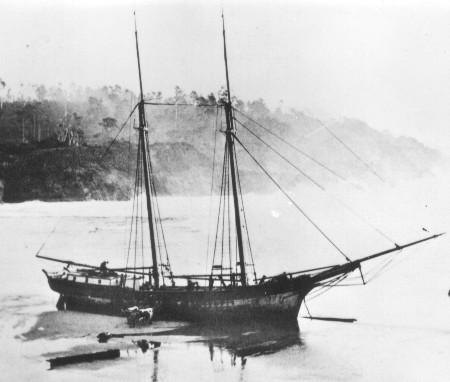
The photograph below shows the lumber schooner, Ella Florence. The Mendocino Saw MIlls—later the Mendocino Lumber Company—was the owners of the Ella Florence. According to a database of the California State Lands Commission, the Ella Florence was stranded in 1868 off the coast of Mendocino and also parted its moorings there in 1872. The photograph supposedly documents that last incident. This may account for the team of oxen, barely visible in the center of the photo. Perhaps the oxen were there to pull some cargo off the ship resting on the sand.

At the San Francisco Maritime National Park, visitors will have an opportunity soon to see one of the old lumber schooners, the C.A. Thayer. Currently being restored, the Thayer was built in 1895 in a northern California shipyard. With a deck length of about 156 ft and a depth of 11.38 ft, the Thayer is typical of the small ships that carried redwood along the northern coast to San Francisco. Her cargo capacity was 575,000 board feet, about the equivalent of ten railroad cars. Manning the ship was generally a crew of about eight or nine men. They lived and slept in the forward part of the bow in conditions that would seem cramped even to an experienced submariner.

Photo Credits
First sawmill from Robert J. Lee Collection (Ukiah).
Lumber schooner photo from Robert J. Lee Collection (Ukiah).
Secondary Sources
Bear, Dorothy and Beth Stebbins. Menodcino: Book Two, Gulf Press: Privately printed, 1977.
Jackson, W. Francis. Big River Was Dammed. Mendocino, CA: FMMC Books, 1991.
Ryder, David Warren. Memories of the Mendocino Coast, San Francisco, CA: Privately Printed, 1948.
Mendocino County Historical Society (MCHS). Mills of Mendocino County: A Record of the Lumber Industry (1852-1996), 1996.
Williams, Edward C. “The First Redwood Operations in California.” Pioneer Western Lumberman 58 (July 1912): 9-13.

Big River Dams

Big River is the site of the earliest logging camps and dams in Mendocino County. The first saw mill was built on a promontory near the mouth of Big River, called, today, the Mendocino Headlands. As one might expect, the early lumbermen initially cut the trees that were most accessible to the saw mill. In the virgin forest, towering old growth was everywhere—in plain sight. Bull teams pulled the logs up an incline to the sawmill; later iron tracks and rail cars did that job.

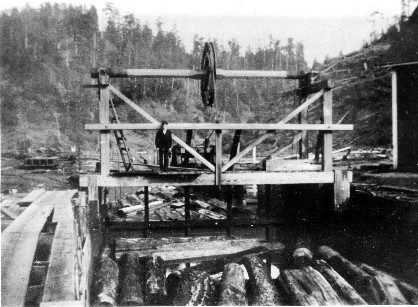
As logging progressed to areas more and more remote, the mill became dependent upon Big River for transportation, since, as yet, there were no railroads in the Mendocino forests. In seasons when there was sufficient water, harvested logs could be floated downstream to enclosures at the mouth of the river, called booms; sometimes logs broke loose from the enclosure and floated out to sea. Eventually dams were constructed to artificially raise water levels in drier seasons. Water was collected behind the gates of a splash dam. When a gate was tripped, a flash flood would move the logs downstream. Dams could be synchronized to trip their gates at just the right moment in order to maximize the flow of water downstream. Occasionally, there were log jams, in some cases lasting 2 or 3 years. The only solution was to blast the jam and in the process blast boulders, fish, vegetation, and anything else in the river channel. The first dam on Big River, Little Northfork, was 11 miles from the saw mill; the furthest dam, 48 miles. (Jackson, 2).The Mendocino Mill Company (1855-1872) and its successor the Mendocino Lumber Company (1873-1905) used “river drives” more extensively than any other timber operation on the North Coast (Graham Matthews 3).

In his book, Big River Was Dammed, W. Francis Jackson documents at least 27 dams on Big River. Jackson recalls how he walked the river banks and reminisced about his many relatives who had worked on Big River and filled a young boy’s head with stories of logging camps, bull teams, and log rafts. The largest of the dams that Jackson documents used over 1 million feet of timber in its construction (Jackson, p.2). The dams, which were major threats to aquatic wildlife, are gone. The last log drive and operation of the dams was in 1937; the result was a log jam (Jackson 104). Some dams fell into ruin over time, although there is lingering evidence of their presence. The California Department of Fish and Game called for the destruction of others in order to allow for the migration of fish.

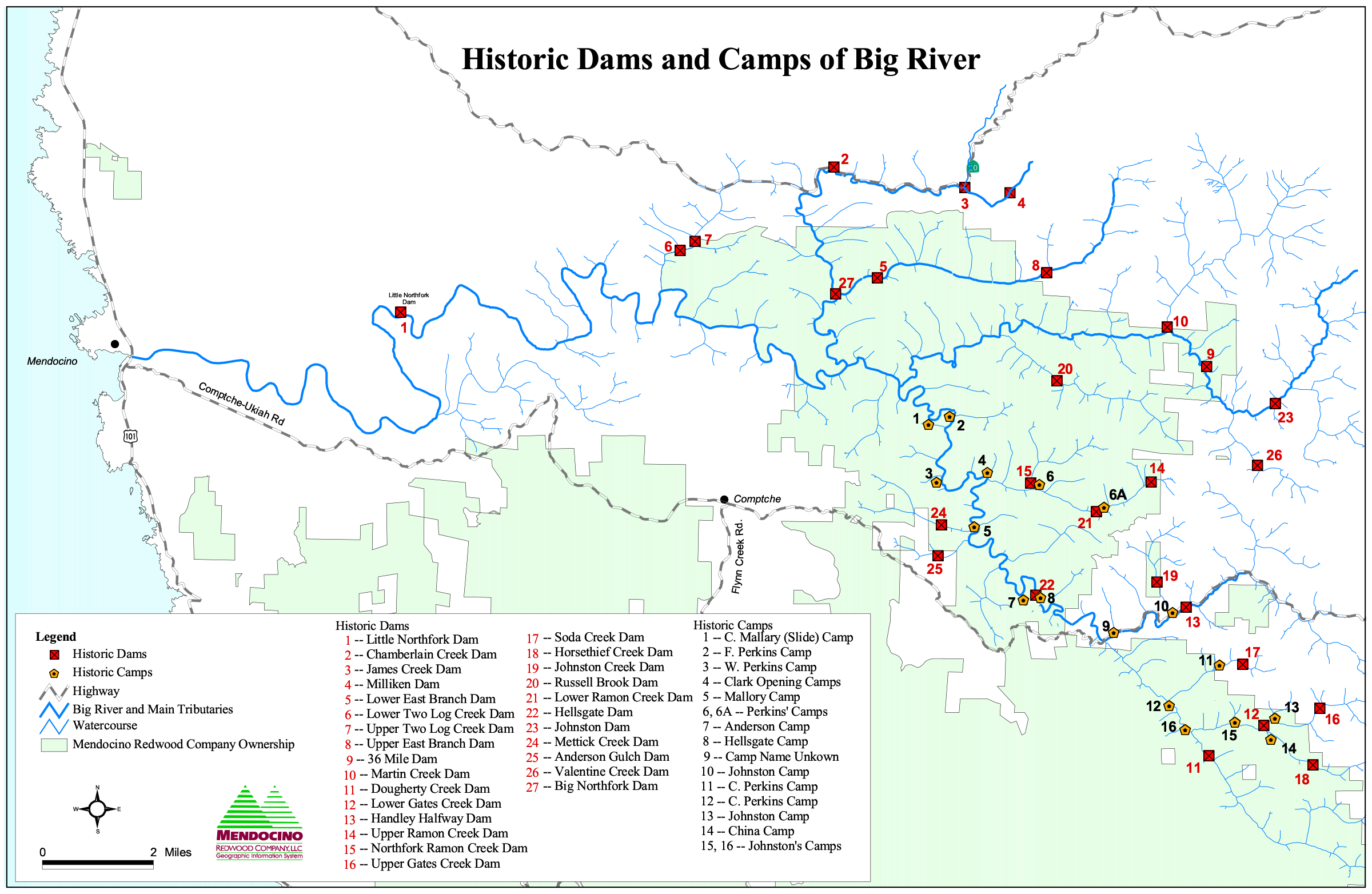
Many of the locations of the historic Big River dam and logging camps are on MRC land. The logging dams and their approximate construction dates are listed below; locations in red are either on MRC land or very close to our property boundary (Jackson, 4):

1. Little Northfork (1860)
2. Chamberlain Creek (1860/1870)
3 .James Creek (1860/1870)
4. Milliken (1860/1870)
5. Lower East Branch (1860/1870)
6. Lower Two Log Creek (1860/1870)
7. Upper Two Log Creek (1870/1880)
8. Upper East Branch (1870/1880)

10. Martin Creek (1883)
11. Dougherty Creek (1885)
12. Lower Gates Creek (1886)
13. Handley Halfway (1887)
14 Upper Ramon Creek (1888/1890)
15. Northfolk of Ramon Creek (1888/1890)
16. Upper Gates Creek (1892)
17. Soda Creek (1892)
18. Horsethief Creek (1893)

19. Johnston Creek (1900)
20. Russell Brook (1907)
21. Lower Ramon Creek (1909)
22. Hellsgate (1913)
23. Johnston (1914)
24. Mettick Creek (1915)
25. Anderson Gulch (1917)
26. Valentine Creek (1919)
27. Big Northfolk (1924)

Jackson provides numerous photographs in his book on the Big River dams. Below, however, is a rather unusual photo showing the wheel and cable to open the dam gate.

Photo Credits
First sawmill from Robert J. Lee Collection (Ukiah).
Lumber schooner photo from Robert J. Lee Collection (Ukiah).
Secondary Sources
Bear, Dorothy and Beth Stebbins. Menodcino: Book Two, Gulf Press: Privately printed, 1977.
Jackson, W. Francis. Big River Was Dammed. Mendocino, CA: FMMC Books, 1991.
Ryder, David Warren. Memories of the Mendocino Coast, San Francisco, CA: Privately Printed, 1948.
Mendocino County Historical Society (MCHS). Mills of Mendocino County: A Record of the Lumber Industry (1852-1996), 1996.
Williams, Edward C. “The First Redwood Operations in California.” Pioneer Western Lumberman 58 (July 1912): 9-13.
Author: DMS
Photo Credits
Transporting logs on Big River. Robert J. Lee Collection.
Dam gate, Kelly House (Mendocino) Collection.
Secondary Source
Jackson, W. Francis. Big River Was Dammed. Mendocino, CA: FMMC Books, 1991.

UP NEXT

04) Rockport