Biographies
There is properly no history, only biography.
Ralph Waldo Emerson (1803-1882)
The biographies on this web site are just simple sketches of a few explorers and entrepreneurs who played a role in the European "discovery" of northern California and in the history of logging in Mendocino County.
The early logging pioneers are particularly relevant, of course, to the history of MRC ltimberland.but our interest in them goes beyond the logging industry itself. Clearly, there was a mental and physical toughness in the pioneers that built the United States.
The first trails that they walked were barely visible, carved out by Indians and, before them, by wild animals, like migrating buffalo, deer, and mustangs. These early trails led to water and grass, through mountain passes and along rivers, toward safety and away from predators.
The first pioneer shelters were tents, wagons, and the spreading branches of trees; their “permanent” houses were spare and drafty, built with basic tools and their own two hands. Food was limited to what they could hunt. Water and sometimes breakfast and supper came from the same stream. They patched their wounds as matter-of-factly as they patched their trousers, and sometimes with the same needle. If we want to understand these individuals, we have to realize that they were people just like us, with fears and hopes, trials and dreams, joys and failures. They faced challenges and devised solutions based on their own vision of the world, their own ingenuity, and their own moral perception.
While some may disagree with their motives and methods or despair at their lack of environmental consciousness and cultural sensitivity, we will never understand them if we cannot get beyond our own knowledge, experience, and world view. We must become, in a real sense, explorers ourselves of a human context different from our own. To do so will, in some cases, reveal a determination and resilience in these early Americans that is almost breathtaking.
Cabrillo
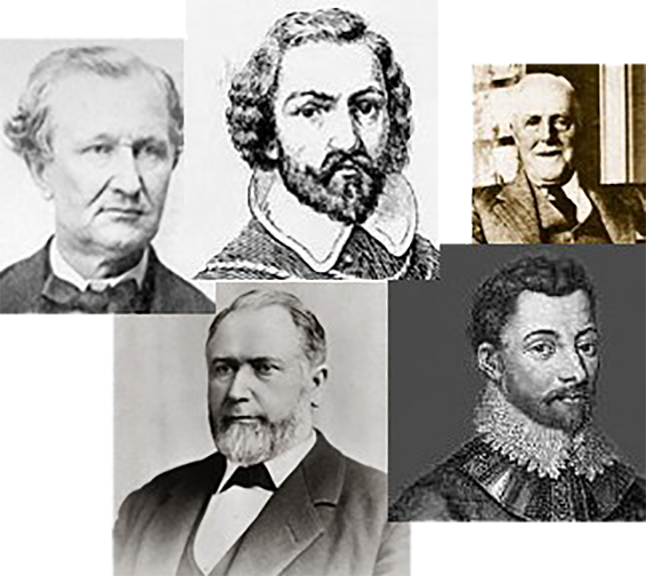
Juan Rodriguez Cabrillo was the first known explorer of the California coast. Around 1519, he fought for the conquest of Mexico with the famous conquistador Hernan Cortes. By 1542, Cabrillo was exploring the California coast under the Spanish flag, hoping to find wealthy cities or Cibola. He reached San Diego bay, on September 28, 1542, naming it “San Miguel”. Within a few days, Cabillo departed San Diego to explore the uncharted coast line of California. While he died unexpectedly on January 3, 1543, his chief pilot, Bartolomé Ferrelo, continued the trip northward and reached the Mendocino coast.
Autor: DMS
Image Credits:
Death of Cabrillo, illustration from Voyage of Discovery (1542-1543) with permission of the Cabrillo National Monument Foundation.
Sir Francis Drake
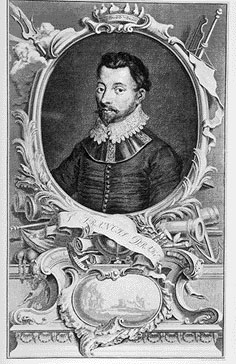
After being delayed over a month by severe storms, Sir Francis Drake set sail from Plymouth, England on December 13, 1577. Whether or not he actually intended to circumnavigate the globe is uncertain (Whitfield, 38). Nevertheless, almost 3 years and 36,000 miles later, Drake’s ship, the Golden Hind, returned to England having done just that. One of the most debated episodes of this entire voyage was Drake’s visit to California and his founding of Nova Albion—New Albion. In his naming of the territory, Drake was following the fashion of the times, since Albion was the classical name for England and he was claiming the land for the English monarch, Elizabeth I.
“Like all good historical stories,” Peter Whitfiield writes,”that of Drake’s visit to California has thrived on its mysteries” (Whitfield, 67). According to The World Encompassed (1628), Drake sailed 2500 miles along the California coast, all the way up to 48° latitude—very close to what is now Seattle, Washington. He then, supposedly, dropped down to 38 ° latitude, near present day San Francisco. Here he made anchor for 5 weeks. During that time, the local Indians treated Drake and his men with great respect and generosity, almost as though they were “gods.” Scholars have speculated that the location of New Albion may have been Drake’s Bay, north of San Francisco.
In 1936 someone found a crudely chiseled brass plate on a ridge overlooking San Francisco Bay, purportedly the one left by the Drake expedition. The plate became a prominent exhibit at Bancroft Library on the University of California campus at Berkeley. Years later the plate was exposed as a hoax but the perpetrators were never identified. On February 18, 2003, Kathleen Maclay, from campus media relations, reported that new researchers, while lacking a “smoking gun,” now believe the hoax was perpetrated by some members of the California Historical Society, an art restorer, and a former director of the Bancroft LIbrary—all as an “insider’s joke.”
No matter where Drake actually made landfall, his California visit was important for more reasons than glory and empire. As Robert Heizer, a leading authority on California Indians, points out, Drake was “the first Englishman to see and describe the Indians of Upper California” (Heizer, 251). Heizer believes that Drake encountered the Coast Miwok Indians. The culture of the Coast Miwok and the Pomo, historically the major Indian group in what is now Mendocino County, are “almost indistinguishable” (Heizer, 278). Perhaps, in one passage from The World Encompanssed that Heizer includes in his article, we get the only glimpse we will likely have of what the early inhabitants of MRC land might have been like at the time of European explorers.
They are a people of a tractable, free, and loving nature, without guile or treachery; their bowes and arrowes (their only weapons, and almost all their wealth) they use very skillfully, but yet not to do any great harme with them, being by reason of their weakenesse, more fit for children than for men, sending the arrow neither farre off, nor with any great force: and yet are the men commonly so strong of body, that that, which 2. or 3. of our men could hardly beare, one of them would take upon his backe, and without grudging carrie it easily away, up hill and downe hill an English mile together: they are also exceeding swift in running, and of long continuance; the use whereof is so familiar with them, that they seldom goe, but for the most part runne. One thing we observed in them with admiration: that if at any time, they chanced to see a fish, so neere the shoare, that they might reach the place without swimming, the would never, or very seldome misse to take it. (Heizer, 290)
As for Drake himself, one of his biographers says that we will never know him with real intimacy—as is the case with many heroes, even those within our own times. Was he a fearless explorer or just a pirate? A leader or a loner? “One of the problems with Drake is that we have virtually no words of his own or documents from his own hand, ” writes Peter Whitfield. “The man’s personality, his inner life, his ideas and motives, are hidden from us: all we have are his actions, and their interpretation is open to deep disagreement.” (Whitfield, 8) History, of course, is as much about enigmas as undisputed dates and facts—perhaps more so!
Author: DMS
Secondary Sources:
Heizer, Robert. Francis Drake and the California Indians, 1579. Berkeley: University of California Press, 1947. From University of California Publications in American Archaeology and Ethnology, 1946,Vol. 42, No. 3, pp. 251-302.
Whitfield, Peter. Sir Francis Drake. New York: New York University Press, 2004.
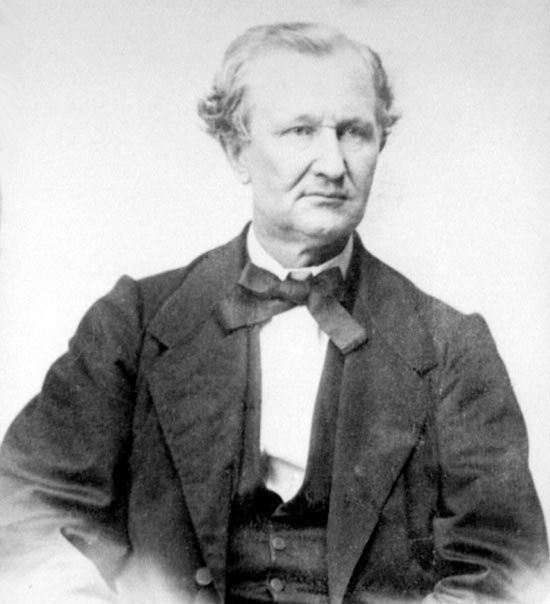
Henry Meiggs
Nothing in this world can take the place of persistence. Talent will not; nothing is more common
than unsuccessful people with talent. Genius will not; unrewarded genius is almost a proverb.
Education will not; the world is full of educated derelicts. Persistence and determination alone are omnipotent.
The slogan “press on” has solved and always will solve the problems of the human race.
J. Calvin Coolidge (US President 1923-1929)
I’m a great believer in luck, and I find the harder I work, the more I have of it.
Thomas Jefferson (US President 1801-1809)
Americans always love a success story, particularly when the hero comes from the ranks of the common man. The entrepreneurs who opened up the logging industry in northern California were not well educated, socially polished, winners of talent contests, or paragons of virtue. They were, for the most part, common men, who believed in success, brushed off failure, and convinced others to buy into their vision. When they failed, they failed forward. Henry “Honest Harry” Meiggs is a case in point.
WANTED // Entrepreneur
Immediate opening for high risk position. Must be able to see new opportunites recognize market needs, and act quickly before someone else beats you to it. Must know how to sell a "crazy idea" to sober bankers and timid investors.
Above all must be confident and determined, able to survive uncertain markets, fierce competitors, and personal problems. Fearful conformists need not apply.
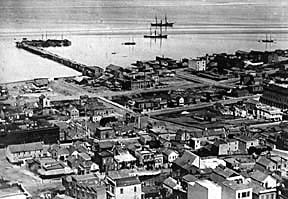
Born in Catskill, New York on July 7, 1811, Henry Meiggs first worked in his father’s shipyard, building piers and small boats. Business was good. Before railroads and highways, rivers were America’s main arteries of transportation and commerce..By necessity, America’s early colonists lived mainly by water, not deep in the woods or high on the mountaintops. The most important river in America’s early history was the Hudson River, defended by America’s early Revolutionaries, used for commerce, and celebrated by writers and pastoral painters for its beauty. The Hudson River ran for 315 miles from its headwaters in the Adirondacks, through small town America—Saratoga, Catskill, Poughkeepsie, Cornwall, West Point, Yonkers—finally spilling out into the Atlantic Ocean at New York City.
Perhaps as inevitably as the Hudson River itself, Meiggs made his way to the big city, fired with dreams and ambition. Before he turned 21, he married Gertrude Burns on April 9, 1832. One year later, on April 12, they had a son, William. Within seven months of William’s birth, Meiggs buried his wife. A widower and single father, Meiggs worked as a Manhattan lumber dealer and contractor, managing to amass a moderate fortune within a couple years. The 1830s, however, were a decade of wild financial speculation and spending. Fortunes were made and quickly lost. Meiggs’ lumber business was among many that failed. In an age when there were no social programs for unemployment, Meiggs, like others of his generation, turned to family for survival—if they were lucky to have one. Meiggs moved near his married sister in Williamsburg, a town that later became part of Brooklyn, and joined his brother-in-law’s lumber business. Henry Meiggs pressed on.
On September 7, 1835, Meiggs married a second time to Caroline Doyle. She became at once a new wife and a mother to William, who was not yet 2 ½. Struggling to raise a family, Meiggs would learn that the financial roller-coaster ride was not over. The Panic of 1837 hit New York City on May 10; all banks stopped payment in gold and silver coins. This was the start of a six-year economic depression in which banks failed, unemployment soared, public construction projects halted, and people rioted in the streets of New York City for food. Life goes on, however, even in times of economic or social turmoil. In 1839, Meiggs and Caroline had their first child together, a son, Carroll. He lived about 3 weeks past his second birthday. In 1842, Caroline bore another child, a girl also named Caroline. Little Caroline died 3 months before her own second birthday. Childbirth and childhood were dangerous times in 19th century America.
By 1848, having heard about the Gold Rush, Meiggs set his sites for California. However, the 38-year old, Meiggs did not intend to sift California rivers or dig California valleys for gold. Loading a ship, the Albany, with lumber, he set sail for San Francisco with his family in early 1849. His family now included teenager, William; 3 1/2-year old, Henry; and an infant son, Manfred, born September 7, 1848. Considering that the trip to San Francisco went from New York, around Cape Horn, and up the California coast—a trip of almost three months at sea—one can only admire the optimism and stamina of these parents. Stepping off the ship at San Francisco, Meiggs and his wife would have seen muddy streets filled with mules, horses, dogs, canvas tents, blanket tents, makeshift houses and stores, brothels, gambling spots, saloons, and more saloons. There would also have been plenty of noise, muck, and aroma—not a golden city, by any means, except in the opportunities it offered to make quick money. Reportedly Meiggs sold the lumber he brought from New York for twenty times what he paid for it and began his short career as a California businessman. In a little more than a year after coming to San Francisco, however, tragedy struck the Meiggs family again. William died on September 9, 1850, scarcely more than 17 years old. Henry Meiggs pressed on.
Born in Catskill, New York on July 7, 1811, Henry Meiggs first worked in his father’s shipyard, building piers and small boats. Business was good. Before railroads and highways, rivers were America’s main arteries of transportation and commerce..By necessity, America’s early colonists lived mainly by water, not deep in the woods or high on the mountaintops. The most important river in America’s early history was the Hudson River, defended by America’s early Revolutionaries, used for commerce, and celebrated by writers and pastoral painters for its beauty. The Hudson River ran for 315 miles from its headwaters in the Adirondacks, through small town America—Saratoga, Catskill, Poughkeepsie, Cornwall, West Point, Yonkers—finally spilling out into the Atlantic Ocean at New York City.
Perhaps as inevitably as the Hudson River itself, Meiggs made his way to the big city, fired with dreams and ambition. Before he turned 21, he married Gertrude Burns on April 9, 1832. One year later, on April 12, they had a son, William. Within seven months of William’s birth, Meiggs buried his wife. A widower and single father, Meiggs worked as a Manhattan lumber dealer and contractor, managing to amass a moderate fortune within a couple years. The 1830s, however, were a decade of wild financial speculation and spending. Fortunes were made and quickly lost. Meiggs’ lumber business was among many that failed. In an age when there were no social programs for unemployment, Meiggs, like others of his generation, turned to family for survival—if they were lucky to have one. Meiggs moved near his married sister in Williamsburg, a town that later became part of Brooklyn, and joined his brother-in-law’s lumber business. Henry Meiggs pressed on.
On September 7, 1835, Meiggs married a second time to Caroline Doyle. She became at once a new wife and a mother to William, who was not yet 2 ½. Struggling to raise a family, Meiggs would learn that the financial roller-coaster ride was not over. The Panic of 1837 hit New York City on May 10; all banks stopped payment in gold and silver coins. This was the start of a six-year economic depression in which banks failed, unemployment soared, public construction projects halted, and people rioted in the streets of New York City for food. Life goes on, however, even in times of economic or social turmoil. In 1839, Meiggs and Caroline had their first child together, a son, Carroll. He lived about 3 weeks past his second birthday. In 1842, Caroline bore another child, a girl also named Caroline. Little Caroline died 3 months before her own second birthday. Childbirth and childhood were dangerous times in 19th century America.
By 1848, having heard about the Gold Rush, Meiggs set his sites for California. However, the 38-year old, Meiggs did not intend to sift California rivers or dig California valleys for gold. Loading a ship, the Albany, with lumber, he set sail for San Francisco with his family in early 1849. His family now included teenager, William; 3 1/2-year old, Henry; and an infant son, Manfred, born September 7, 1848. Considering that the trip to San Francisco went from New York, around Cape Horn, and up the California coast—a trip of almost three months at sea—one can only admire the optimism and stamina of these parents. Stepping off the ship at San Francisco, Meiggs and his wife would have seen muddy streets filled with mules, horses, dogs, canvas tents, blanket tents, makeshift houses and stores, brothels, gambling spots, saloons, and more saloons. There would also have been plenty of noise, muck, and aroma—not a golden city, by any means, except in the opportunities it offered to make quick money. Reportedly Meiggs sold the lumber he brought from New York for twenty times what he paid for it and began his short career as a California businessman. In a little more than a year after coming to San Francisco, however, tragedy struck the Meiggs family again. William died on September 9, 1850, scarcely more than 17 years old. Henry Meiggs pressed on.
While Meiggs was making considerable money in his lumber business, he was also spending considerable money on North Beach real estate deals that did not prove as profitable as he had expected. Interest on loans and taxes on property began to mount. With the depression of 1854, Meiggs was faced with huge debts—some estimates put the amount as much as $1,000,000 with the interest alone between $30-40,000 a day (Harker, 196). A San Francisco alderman, Meiggs apparently had access to a book of blank city warrants, already signed by the major and the city comptroller. “Hnoest Harry” forged the warrants and presented them as collateral for his loans.
At this point, a melodrama, worthy of any 19th century theater, unfolded. Reportedly, Meiggs skipped town with a “fire burning in the hearth and the birds singing in their cages.” Sometime in early October, 1854, Meiggs quietly loaded everything from his San Francisco mansion at Broadway and Montgomery, including vintage wines and $10,000 in gold, onto the ship, American, which, not coincidentally, one would guess, had four small cannons mounted on its deck (Averbuch, 20). In darkness and lifting fog, Meiggs sailed for South America with his family and his brother, John, the newly elected city comptroller of San Francisco. With daylight, angry creditors mounted a search for Meiggs. His creditors included William Tecumseh Sherman, who would prove to be a better Civil War general than a banker. Sherman was a partner in a St. Louis banking firm operating in San Francisco at the northeast corner of Montgomery and Jackson. Of those wild days of financial speculation that brought the ruin of Meiggs and others, Sherman later reminisced: “I can handle a hundred thousand men in battle, and take the City of the Sun, but am afraid to manage a lot in the swamp of San Francisco” (Royster, 133-4). A court subsequently indicted Meiggs for fraud but, in South America, he was quite beyond the reach of California law. Henry Meiggs pressed on.
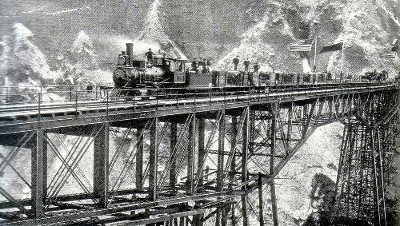
In Chile, Meiggs and Caroline had their last child, Fanny Kip, born October 26, 1856. Despite his detractors, Meiggs wrote to Laura Nelson from Santiago, Chile on September 11, 1859, that “my hopes are still strong, and my spirit uncrushable, notwithstanding what has been said and written of me.” On Christmas Day, 1861, Meiggs suffered yet another loss, when his wife died in Santiago. Throwing himself into work, Meiggs constructed, by 1867, about 200 miles of railroad in Chile, much of it along the coast. In 1868 he went to Peru, where there were less than 60 miles of railroad track. With only an elementary school education, quite typical for the times, Meiggs, with the assistance of engineers J.L. Thorndyke and E. Malinowski, built the beginnings of the most important Andean railroad lines still in existence today. One of them, the Callao-Lima-Oroya railroad, was the highest standard gauge railway in the world, crossing the Andes at about 17,000 ft above sea level. Meiggs would boast “I will lay tracks where llamas walk.” Meiggs imported rail cars from the eastern United States and rails from England. And the railroad ties? California redwood! As a contractor, Meiggs used redwood ties for other Peruvian rail projects as well. Writing about the Oroya Railroad for Scribner’s magazine in August, 1877—just a month before Meiggs death on September 30th—J. Eglinton Montgomery lionizes the American entrepreneur, saying that “the Oroya Railroad must take rank in the history of modern engineering as a work of the first magnitude, without a rival” (Montgomery, 462).
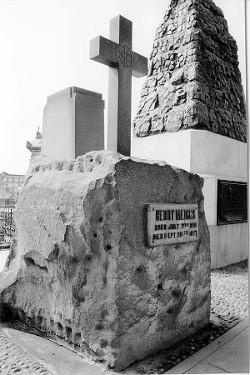
In constructing the Oroya railroad, Meiggs had to blast the Galera, a tunnel about 3,847 feet in length at an altitude of 15,645 feet. In sight of Galera tunnel is Mount Meiggs, where the Peruvian and U.S. flags once flew together on its snowy summit (Montgomery, 459). Fittingly, a boulder from Galera tunnel marks the grave of Henry Meiggs in Lima, Peru. At the time of his death, Meiggs was only survived by three of his seven children: Henry, Minor Keith, and Fanny Kip. Significantly, Meiggs, before his death, made restitution to many of his San Francisco creditors, evidenced by the fact that in 1874, the California legislature passed Senate Bill 183 dismissing any previous indictment against him
Author: DMS
Photo Credits:
Henry Meiggs, Kelly House Research Office (Mendocino, CA).
Henry Meiggs Tomb, courtesy of Elio Galessio (Peru).
Verrugas Bridge, built by Meiggs and at the time the highest bridge in the world. Photo shows Engine #13, Santo Domingo, c. 1890, with U.S. and Peruvian flags flying, courtesy of Elio Galessio (Peru).
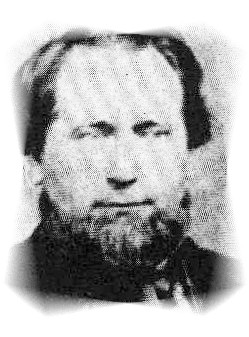
Jerome B. Ford
Jerome Bursley Ford was born in Vermont in 1821. At the age of 28, he came to San Francisco to work for Henry Meiggs. Unexpectedly in 1851, Meiggs sent him north to search for the wreck of the Frolic off the Mendocino coast. While Ford found nothing worth salvaging from the Frolic, he did spot treasure of another sort: giant redwood trees. Ford walked back to San Francisco and reported to Meiggs. Hearing the account of the massive trees, Meiggs ordered a sawmill from the east coast and purchased a ship, the Ontario, to carry it to Mendocino. Meanwhile, Ford drove some oxen overland and arrived in Mendocino on 17 June 1852. Immediately, he purchased land for $100 from William Kasten, the original settler, and staked a claim for Mendocino’s first sawmill at the headlands of Big River.
Upon construction of the sawmill, Ford became the first supervisor.of the California Lumber Manufacturing Company (1852-1855), later known as the Mendocino Mill Company (1855-1873). Aside from business, Ford fathered six children. His son, Jerome Chester, was reportedly the “first white boy” born in Mendocino. Copies of several Ford diaries are in the Kelley House Historical Museum Research Office in Mendocino CA. Anyone searching for introspection and revelations of the inner man will not likely find them in Ford’s diaries. His marriage is reported as succinctly and matter-of-factly as the weather or the number of board feet of lumber cut for the day.
Ford remained in Mendocino until 1873 when he moved to Oakland so his children would have better access to good schools. He was active in business until 1885 and died in Oakland in 1889. Jerome C. Ford took over his father’s interests in the re-christened Mendocino Lumber Company (1873-1905). Many of Chester’s letters describe the day-to-day operations of the company and of life in Mendocino.
Letters of Jerome C. Ford
Letter of 16 April 1886
Mendocino Lumber Co.
Dear Sirs — Your letters of the 12, 13 and 14th are at hand. On account of bad roads, the mail gets in late in the evening now.
I returned yesterday after a hard trip to the woods. The river is up some but has not been high enough yet to drive logs. There was nearly a full head of water let off the East Branch dam last week and the dam was to be full last night so that I hope by this time the logs are driven out. On the main river we will not get logs unless there is a large freshet as the logs are not sacked in. Perkins has driven most of his logs out of the gulch where his dam is. He let off two heads last week and the dam was full when I was there but the logs were not sacked in. It rained last night and looks so much like a heavy rain now that I think Perkins will drive out about all his logs and they will come down. The Swan finished loading yesterday noon. Emma ...is outside. The Electra will not be able to take lumber until the Swan gets away and by that time it may be rough.
I had a long talk with Perkins and went over the lumber he is going to put in this year. It is good size and will turn out more clear than last year. If we are willing to advance him $3 on all logs over the 8000 he puts in this year, I think he will agree to deduct 20% from all logs he put in this year. The scaler will take the size and length of the log and thus he feeds in 1260 ft to the saw. He is coming in the last of the month so let me know your news on this matter.
Yours truly,
J.C. Ford
Letter of 17 April 1886
Mendocino Lumber Co.
Dear Sirs — Your letter of the 15th is at hand. I have only a few minutes to write this morning so cannot answer your letter.
At low water last night our boom gave way at the mill. We had it made fast as usual with lines to the shore. The boom broke in two in the middle and then by getting twisted the 4 1/2 in. lines to the shore got cut off on a chain. This let the boom break in another place and about 200 fins. logs mostly poor ones went to sea...The boom is now secure and none of it is lost. Have been up since midnight.
Some sailors running this morning.
Yours truly,
J.C. Ford
Letter of 28 August 1886
Mendocino Lumber Co.
Dear Sirs — Your letter of the 27th is at hand.
I am glad there is some chance of getting an understanding with the sailors. It would never do to give up to them. Sailor wages affect the whole coast and they should be kept down below $40.
Yours truly,
J.C. Ford
Letter of 17 April 1886
Mendocino Lumber Co.
Dear Sirs — Your letter of the 27th is at hand.
I am glad there is some chance of getting an understanding with the sailors. It would never do to give up to them. Sailor wages affect the whole coast and they should be kept down below $40.
Yours truly,
J.C. Ford
Letter of 8 March 1890
Rev J. S. McDonald
San Rafael
Dear Sir— This church will be without a Pastor [in April]. Mr. Rich will stay for a month or so if we fail to find a man in so short a time.
The Congregation have felt that they could not raise more than $1000 next year so that is all we can offer at present. At the annual meeting, the last of this month, some arrangement may be made about a Parsonage, but of course that is only a question.
We wrote to you asking your advise and help in finding another Pastor to this church. In a letter to Mr. Rich you mentioned Mr. McBride. We feel that we are acquainted with him as he has been here. If he wants to come here at the salary offered the congregation could give him a call without putting him to the trouble of coming here to preach on trial.
Any advise or help you can give will be considered a favor by us.
Yours truly,
Jerome C. Ford
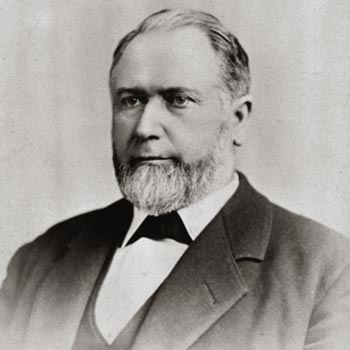
Jerome B. Ford’s granddaughter, Aline M. Pierce, died on May 2, 1993 at the age of 109. She attributed her long life to two things: her nightly martini and her Jaguar—”the only car worth driving.” Mrs. Pierce donated the collection of Carleton E. Watkins photographs of the Mendocino Coast (1863) to the Bancroft Library in memory of her grandfather. Watkins (1829-1916) was a well-known California photographer. He lost his personal collection of plates and photographs when the 1906 earthquake struck San Francisco; in its aftermath, his entire collection was destroyed by fire. This contributed to his physical and emotional break-down. Watkins was committed to a mental institution in Napa in 1910 and was buried on the hospital grounds six years later.
Primary Sources:
Ford Diary (Xerox Copy). Kelley House Museum Research Office. Mendocino, CA.
Secondary Sources:
W. Francis Jackson. Mendocino City: A Daily Journal – 1852-1938. Mendocino CA: Mendocino Historical Research, Inc., n.d..
Photo Credits
Robert J. Lee Collection copied from Alice Earl Wilder Collection.

Harry Merlo as New CEO of Louisiana-Pacific (1973)
Harry Merlo
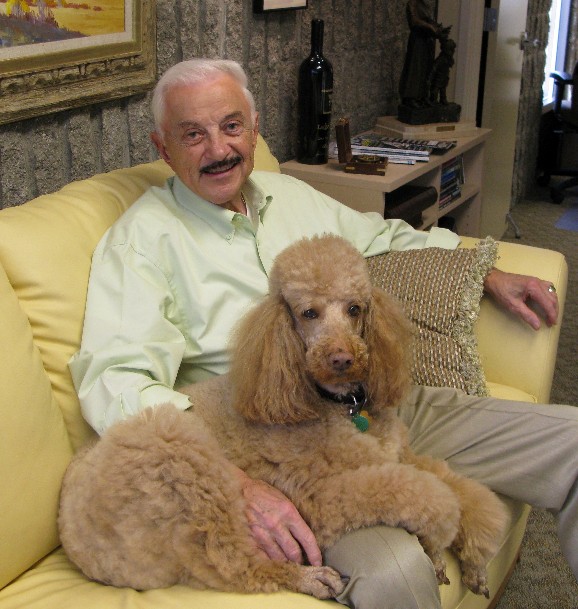
Harry Merlo was CEO of Louisiana-Pacific Corporation (LP) from its launching in 1973 up to his departure in 1995—a very long run by any industry standard. Currently he oversees, with his son Harry Jr., his winery business in Sonoma County, Lago di Merlo. In January 2008, Merlo agreed to an interview at his office in Portland, Oregon. The focus of the interview was Merlo’s role in purchasing the various timberlands in Mendocino County that are now part of Mendocino Redwood Company. In the process, we also tried to catch at least a glimpse of the man, not just the CEO. Most of the personal questions, especially about the pivotal influence of his mother, were sparked by his 2008 autobiography, Vintage Merlo, which was released at the time of the interview . The larger story of LP in Mendocino County as well as related environmental efforts, like Redwood Summer, will be a later undertaking for this history web site.
Interviews, without the aid of video cameras and tape recorders, are tricky to negotiate and especially difficult to translate into print. The interviewer often needs to surround direct quotes with a context of information and with a sense of time, space, voice, and attitude—all the elements that recreate the spoken word, the living person. It’s no wonder that Mark Twain, who sometimes insisted on being interviewed in bed, had few good things to say about interviews. “Sometimes in despair,” Mark Twain said, “they write up a lot the man never said, never intended to say, and couldn’t say if he thought of it.” We have tried to avoid those pitfalls and capture, as best we could, an “inner view” of Harry Merlo rather than just an “interview”.
Read Interview Notes