04) Rockport

Company Towns

Fifty years ago, James Allen made a pioneering effort to study company towns in western United States. He was interested in how company towns developed, what industries spawned them, what the advantages and disadvantages of these towns were for the companies and for the employees, how they affected the economic and social history of America, and why they are disappearing. Some of these towns were coal-mining towns, oil towns, and, of course, lumber towns. “A dramatic illustration of the changing patterns of the lumber industry and its effect upon company towns,” writes James Allen, “is seen in the story of Rockport, California” (Allen, 25).

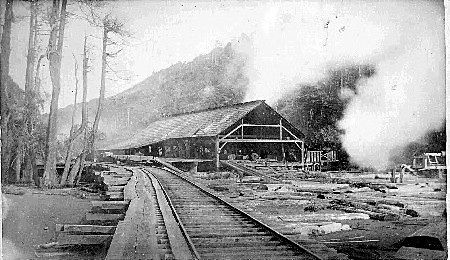
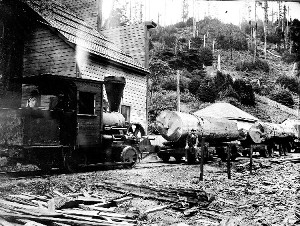
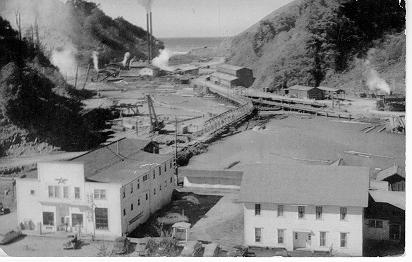
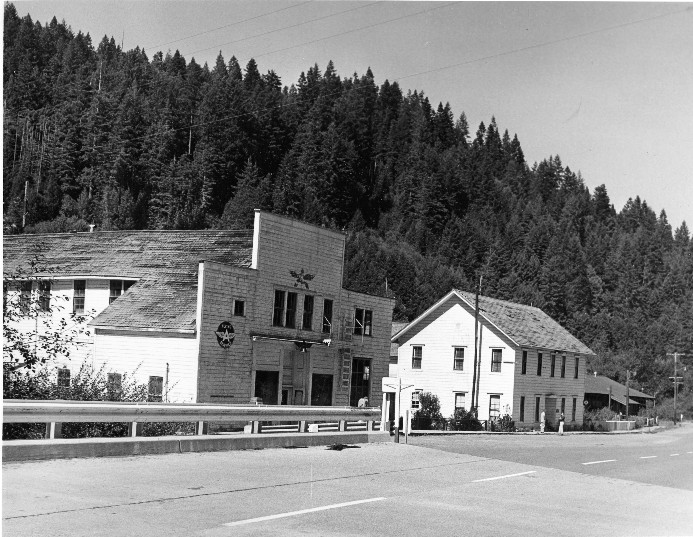
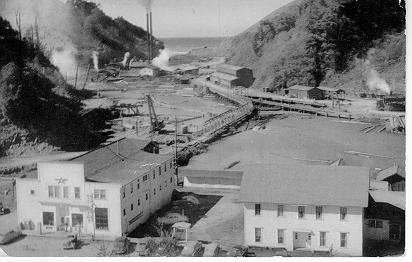
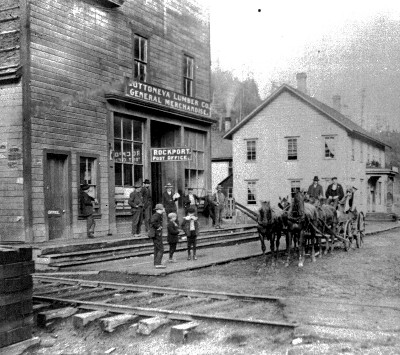
About 25 miles north of Fort Bragg on the rocky Mendocino coast, Rockport, also known at one time as Cottoneva, began as a lumber camp. With its mill right on the coast, timber could be shipped directly south to San Francisco. When Rockport Redwood Company closed the mill in 1957, the population of Rockport was about 500 (Allen, 25).The town included a company store, a community town hall, and a company doctor, in addition to employee housing. The linked map (jpeg 4 MB) shows the layout of the town as it appeared in 1945; use a digital imaging program to enlarge and view the detail. Today only a few of the original houses remain. One of them, remodeled and called the Rockport guest house, is used by MRC employees as a vacation retreat.

“The rise and decline of the town of Rockport,” Allen concludes, “uniquely demonstrates the evolution of the lumber industry, from the early days of a cutting and shipping operation to the present management of sustained-yield forests” (Allen, 25). He adds that the consolidation and development of large timber corporations may be a third factor in the elimination of company lumber towns. The emerging corporations, not wanting to get involved in community management and services (like overseeing water, sewers, street lighting, police protection, routine medical care, and road maintenance) urged employees to purchase homes in nearby towns and relegated the company logging town to oblivion. Of course, there were much larger social impacts at play as well. John Kenneth Galbraith (1958) coined the term “the affluent society” to describe Americans after World War II. As part of that affluence, more Americans had access to automobiles and a growing span of highway. They quickly fell in love with drive-in movies, drive-in restaurants, shopping malls, suburbs, and Sunday drives in the country. Moreover before World War II, few women had careers; their traditional role was wife, mother, and homemaker. Those who did work outside the home were generally secretaries, nurses, and teachers. However, with millions of men needed for the war effort, women took their place in weapons factories, offices, and stores; they became machinists, railroad engineers, and lumberjacks. At the same time, labor unions steadily organized workers in industry after industry, giving them, for the first time, power in negotiations with company owners.

With new mobility, larger aspirations, and bigger paychecks, many found there was much more to life than just the company town. Interestingly, Tennessee Ernie Ford released a record in 1955 of a Merle Travis song about a coal mining town, “Sixteen Tons,” with this soulful refrain:
You load sixteen tons an’ what do you get?
Another day older an’ deeper in debt.
St Peter don’t you call me ’cause I can’t go:
I owe my soul to the company store.

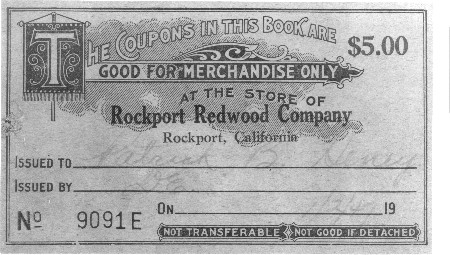
In 11 days this flip-side single sold 400,000 records; in 24 days, 1 million copies; and in less than 2 months, 2 million copies. At the time it was the fastest-selling single in the history of Capitol Records. Clearly this song that even its producers did not expect to be a hit resonated with many Americans. Often workers in company towns, like Rockport, received advances against their salaries with “scrips” that could only be redeemed at the company store. Bernie Agrons, the last general manager of Rockport Redwood Company, talks in a 2007 interview about the Rockport company store in the mid-1950s ( wmv 4 MB). At that time, Jimmy Foreman, who lived with his wife Alice in one of the Rockport staff houses, was the store manager and butcher.

By the 1950s, the timber industry and its workers had changed, along with American society and attitudes. The big timber corporations no longer needed to create company towns in isolated areas in order to keep a workforce and many employees no longer wanted to live a company life. Apart from its importance as a company town, Rockport illustrates the perils and uncertainty of timber investors.and timber workers. With its ups and downs, its natural and financial disasters,its transfer from one owner to the next, from small landowners to out-of-town corporations, Rockport’s story is reminiscent of many in Mendocino County.

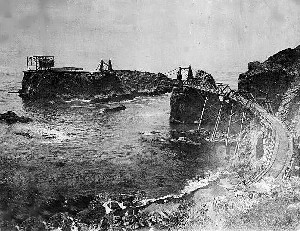
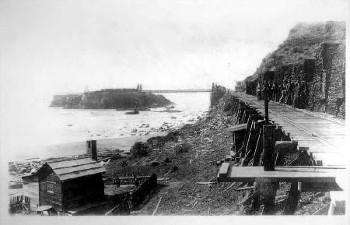
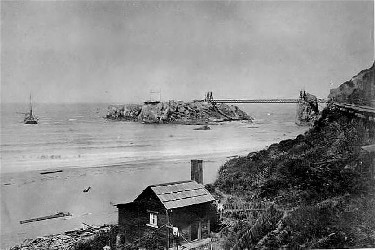
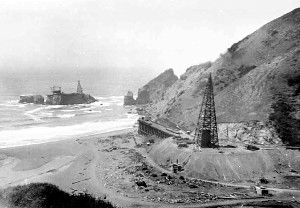
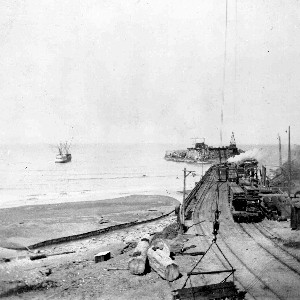
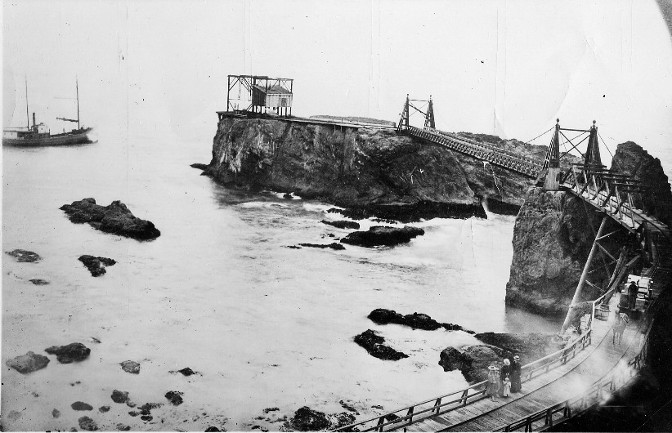
According to records on file at the Bancroft Library, the first sawmill at Rockport was built by William R. Miller around 1877. With a double circular saw, edger, and planer, the mill had a daily capacity of 20,000 board feet (Timberbeast,18). One of the outstanding features at the mill site was a 270 ft wire suspension bridge,built in 1877 by Pacific Bridge Company of San Francisco, that reached from the shore to a small islet in the ocean, sometimes referred to as Pelican Island. Logs were transported by rail to this islet for loading on ships bound for San Francisco.

When he retired in 1886, Miller sold the mill to the Cottoneva Lumber Company. That mill was eventually destroyed by fire in 1900. Around 1907, the Dusenbury family, who owned the New York and Pennsylvania Redwood Company, acquired Cottoneva. They planned to build a new mill at Rockport but their plans never materialized. By 1925 Finkbine-Guild Lumber Company out of Jackson, Mississippi bought Cottoneva Lumber Company. Facing financial ruin, they too abandoned operations in 1927 and their assets were acquired by the Great Southern Lumber Company of Bogalusa, Louisiana to form the Southern Redwood Company.

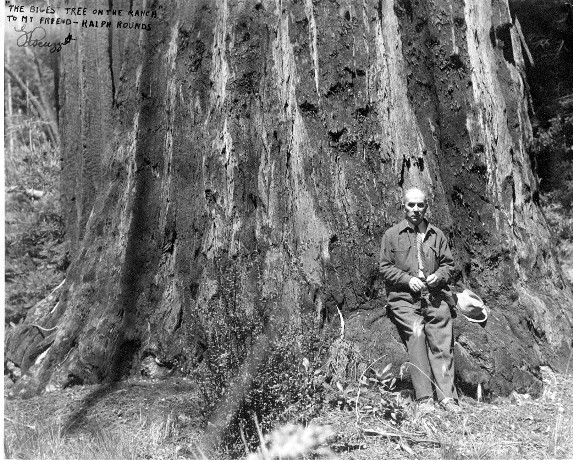
Within two years, Southern Redwood Company also shutdown. In 1933 the Dusenbury family foreclosed on the original defaulted bonds of Finkbine-Guild and chartered the Cottaneva Redwood Company. Ralph Rounds of Wichita, Kansas, in 1937, took a lease to operate the Cottaneva Redwood Company. The company was renamed Rockport Redwood Company in 1941. Operations at that time included a sawmill, a company town, and approximately 36,000 acres of timberland. The Rockport mill finally fell to competition and closed its doors in 1957. Following Rounds death in 1960, the mill was dismantled and auctioned off. That same year, the Rockport Redwood Company certified the timberlands as the Ralph M. Rounds Tree Farm, selling timber to neighboring companies. The term “tree farm” originated two decades earlier in the 1940s, as the timber industry introduced the concept of sustainable forestry and continual stewardship. Farming implies continuous nurturing and commitment to a “crop” year after year. Tree farming was the polar opposite of the “cut-out and get-out” strategy of some timber industrialist.

Ralph C. Round, the elder’s heir, sold the Ralph M. Rounds Tree Farm and the town of Rockport to Georgia-Pacific on July 30, 1968. In 1973 the Rounds Tree Farm, the Georgia-Pacific timberlands throughout northern California, and the former town of Rockport was spun off into Louisiana-Pacific. MRC purchased the Louisiana-Pacific lands, including the Rockport townsite, in 1998.

Primary Source
Rockport Redwood Company Records, BANC MSS 70/184 c, The Bancroft Library (Berkeley, CA).
Secondary Sources
Allen, James B. The Company Town in the American West. Oklahoma: University of Oklahoma Press, 1966.
Columbia River and Pacific Northwest Timberbeast, Pacific Lumber No. 29.
Westport. Mendocino Historical Review (Summer 1978), vol. 4, number 4.
Photo Credits
Rockport Mill, Robert J. Lee Collection, Held-Poage Research Library (Ukiah, CA).
Rockport coupon book, Robert J. Lee Collection.
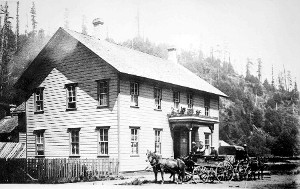
Cottoneva Hotel (c. 1900), Robert J. Lee Collection, Held-Poage Research Library (Ukiah, CA).
Photo Links
Rockport guest house, photo by Doris M. Schoenhoff (2005).
Rockport suspension bridge and rails. Robert J. Lee Collection (Ukiah, CA).
Video
Video interview of Bernie Agrons, Rockport Guest House, 6 May 2007, conducted by Doris M. Schoenhoff.
Linked Map
A copy of the 1945 flood map of Rockport was discovered (2007) in the MRC vault by Roger Krueger, an MRC consultant.

Miller Sawmill

The timber pioneers at Rockport, California were not far removed from the early pioneers that opened the American West. Their task ahead— logging giant redwood trees from mountain slopes and shipping them from a lonesome rock in a threatening sea—seemed impossible, as often did their own survival. Hardships, discoveries, ingenuity, determination—this was all just part of the “pioneer spirit.” The man who took up the challenge of building the first sawmill at Rockport was William Ramsey Miller.

Born in Scotland on May 2, 1832, Miller emigrated to the United States at the age of 24. Within two years, he was a new California resident. In the early years, he described himself as a merchant; though later he would become a “lumberman.” Just about the time that he was embarking for Rockport, a reporter interviewed Miller and described him as “a man of great energy, polite, and very hospitable” (Douglass, p. 78). He and his wife had lost their first child, Ida Florence, in 1874 when she was 7 years old; a second daughter, Henrietta, was born in 1873 (Douglass, p. 78). His last child, William David, would be born in 1879 and grow up in Rockport (Douglass 129).

In October, 1876, the schooner David and Edward set sail for northern California with the mill machinery on board. Rather inauspiciously, the ship ran aground on the beach. However, for now, the damage to the equipment was minimal and work on the new sawmill quickly got underway. With a double circular saw, edger, and planer, the new mill had a daily capacity of 20,000 board feet. One of the outstanding features at the mill site was a 270 ft suspension bridge, built in 1877 by Pacific Bridge Company of San Francisco—likely, at the time, the longest suspension bridge on the California coast. The bridge reached from the shore to a small islet in the ocean—sometimes referred to as Pelican Island. The mill shipped its first consignment of lumber on October 9, 1877—140,00 ft. (MB 13 Oct 1877). Less than two months later, the bridge was battered by a severe storm. The Mendocino Beacon reports on December 1, 1877 that a bridge brace was knocked out, lumber piled on the bridge was washed away, and “a house and about 8,000 feet of lumber” on the “island rock” were carried out to sea.

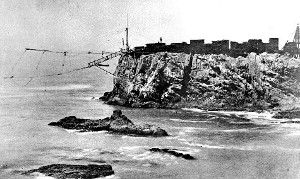
In addition to the suspension bridge, there was an apron chute—so called because it resembled a woman’s apron held out by its lower corners—projecting from the southern end of the islet. A half-mile tramway ran from the mill over the bridge and across the isle to the chute. Lumber was lowered from chute to an awaiting ship. All this equipment was, as one researcher has said, “an astounding financial and technological investment for a redwood coast sawmill” (Douglass, p. 127).

Another interesting feature of the sawmill operations was the large mill pond for collecting and sorting logs. Apparently, the pond was created by damming Cottoneva Creek and extended for about half a mile to a depth of 12 or 13 feet:

Mendocino Beacon January 26, 1878
The Cottoneva mill will start up shortly; they have about 2,000 logs barked and sawed, and thirteen men employed. At this place they have a substantial dam that backs water about 800 or 900 yards, drawing 12 or 13 feet of water that distance. During the storm [MB, 1 Dec 1877] the wire suspension bridge here received a severe test as to its solidity. The spray flew all over it without effect. Travel to this place by land is out of the question just now. There is no wagon road, and this is a matter that should be looked after, as the place is gradually being settled and a mere trail over the mountains to connect with a wagon road will not answer the wants of the community.

As early as 1876, a William McGowan and John Crranston were raising and experimenting with salmon; they planned to build a hatchery near the Cottoneva Creek that ran alongside Miller’s sawmill and opened into the ocean. Noting this in his report, the Rockport correspondent, nicknamed “Wanderer,” also boasted in the Mendocino Beacon (10 Dec 1879) about the Miller sawmill and suspension bridge, and the fact that a new hotel was about to be built near the original residence of L. Dodge, supposedly the first “white settler” at Cottoneva Creek about 1863.

Mendocino Beacon December 20, 1879
…who knows, but that one day is not far distant when we may have such a things as a post and express office right in the town of Rockport. One thing we can boast of, and that is, of having as fine a saw mill and suspension bridge as can be found on the coast; and the oceans of fine timber to back it; we are also blessed with the go-ahead kind of men to carry on and make business.

John Cranston and Wm. McGowan will, we understand, soon commence the erection of a large fish and salmon hatching house near the mouth of Cottoneva Creek; they have been experimenting in raising and propagating salmon for the last three years, and are well satisfied that is will prove a remunerative business. Mr Gowan has taken a lot of salmon eggs East with him (where he has gone on a visit) for gratuitous distribution, as he is well satisfied they will flourish in Canadian waters. They (Mr. McGowan and Cranston) also contemplate the erection of a fine hotel on or near the residence of L. Dodge, where Mr. McGowan will continue the practice of his profession of Dentistry. …All we want now is a wagon road to Westport to make us happy and to give us wagon communication with the outside world.

Interestingly, Miller generally employed Chinese laborers at the mill, the only mill on the Mendocino coast that did so “almost exclusively” (Brinzing as cited in Douglass 128). What makes this remarkable is that, since the influx of Chinese into California during the Gold Rush, there were threats, violence, even riots against Chinese workers, as well as discriminatory legislation. In 1860, for example, California passed a law that forbade Chinese-American children to attend public schools. The Naturalization Act of 1870 excluded Chinese immigrants from becoming US citizens and the Chinese Exclusion Act of 1882 prohibited Chinese laborers, both skilled and unskilled, from entering the United States. It was not until 1943, in fact, that the Magnuson Act repealed the Chinese Exclusion Act. The Chinese that worked in the early lumber camps were usually cooks or laborers. Some were used as “water slingers” with bull team operations. The water slinger went ahead and wet the “skids” to lessen friction on the rolling logs and make it easier for the bull team to pull the load. He would also “grease the skids” with tallow on the level sections of the road. A census shows that 25 Chinese laborers worked at Rockport in 1880. According to Robert Douglass, who has researched Miller’s life, “Chinese workers may have operated some of the mill machinery” (Douglass 128-9). Douglass’ conclusion is based on the fact that apart from an engineer named Allen Pollard, there are no EuroAmericans listed at Rockport with definite sawmill jobs. Miller likely used the Chinese workers to save cost. Rockport’s physical isolation could offer Miller some isolation from public criticism and reprisal as well.

As a result of poor health and likely depleting woods, Miller sold his Rockport holdings in 1886 to a group of investors. After the sale, Miller and his family traveled to Santa Cruz to spend the summer. On June 10, 1887, Miller, having spent the previous night at a dance in Santa Cruz, died in the early hours of the morning of heart failure at age 55.

Photo Credits
Rockport Suspension Bridge. Robert J. Lee Collection, Ukiah, CA.
Apron Chute. RobertJ. Lee Collection, Held-Poage Research Library, Ukiah, CA.
Rockport Mill and Mill Pond c. late 1890s. Robert J. Lee Collection, Ukiah, CA.
Primary Sources
Rockport Redwood Company Records, BANC MSS 70/184 c, The Bancroft Library (Berkeley, California).
Secondary Sources
Robert G. Douglass. “The Sawmill in Miller Gulch: History and Archaeology on the Redwood Coast.” Master’s Thesis, Sonoma State University, 2002.
Mendocino Beacon (microfilm) . Held-Poage Research Library (Ukiah). Vol. 1, No. 2, p. 3.

Rockport Suspension Bridge

The documents reproduced here give three different perspectives on the Rockport suspension bridge. The first is an article from The Mining and Scientific Press. Published in San Francisco beginning in 1860, this was the first mining journal on the Pacific coast. The article gives a “nuts and bolts” description of the bridge construction in progress. Following the article are excerpts from two letters of D. L. Albert. Albert was the secretary of the Cottaneva Lumber Company. The first letter was addressed to W. E. Guild of Finkbine-Guilld Lumber Company, one of the investors who purchased the assets of the Cottaneva Lumber Company in the mid-1920s; the second letter was addressed to the California Redwood Association. Albert gives a more colorful history of the Rockport suspension bridge. As is often the case with “oral histories”, Albert’s memory of when the bridge was constructed conflicts a bit with the article in The Mining and Scientific Press. He adds, however, more human details about the man, W. R. Miller, and his “do it yourself” attitude. Bernie Agrons, the last general manager of Rockport Redwood Company before it ceased mill operations in 1957, re-visited Rockport Beach in 2007 and recounted the building of the suspension bridge.

Mining and Scientific Press
30 June 1877

Mr. R. W. Gorrill, Treasurer and Engineer of the Pacific Bridge Co., gives us the following particulars of a new steel wire suspension bridge which he is erecting in Mendocino county for Mr. W. R. MIller. It is located at Cottoneva, on the coast, and extends from the main land to a rocky island where a chute is to be built for shipping lumber.

The distance from center to center of the saddles on the towers is 270 feet. The deflection or fall of the cable is 23 feet, six inches. The cables are built in the same manner as those of the Clifton bridge at Niagara. The steel wire is No. 11 Birmingham gauge, and is protected against rust by immersing in a bath which gives it a fine coat of zinc. There are 11 wires in each strand, seven strands in each one and one-half inch rope, and seven ropes in each cable. The ropes are not twisted together to form the cables, but gathered up every six feet by the suspender bands. Each rope is warranted to bear a strain of 60 tons. Each rope is made fast to an independent anchor-bar, one by three inches in diameter, and forming links 18 feet long, until connection is made with the anchors. The anchors are of cast iron, three and one-half by three feet in surface, weigh 1,000 pounds each, and are placed 14 feet below the surface of the rock.

Great care was taken in securing these anchors in place by means of cross I beams which run under the rock on either side. The lower par of each pit was enlarged so as to form a hemispherical chamber, and the rock-work, set in Portland cement, which is built upon the anchor, is so constructed that the upward strain is transmitted to its sides. The towers are of redwood. There are four posts 10×10 inches, and two 10×12 inches, giving an effective area of 640 square inches to withstand the strain of the cable on the tower. The wooden truss to prevent vertical vibration is eight feet high of of the Howe truss pattern. The 270 feet of the bridge is divided into 45 pannels. The longest suspenders, 44 in number, are of seven-eight-inch steel wire, the 42 shorter ones are of one and one-eight-inch solid iron.

The estimated dead load of the bridge is 1,000 pounds per linear foot; live load, one tone per linear foot; in all, one and one-half tons, or one-fifth of actual breaking load. The bridge will be completed in about 30 days, and promises to be a structure which the builder may well be proud of.

We were shown a portion of an iron bar from the Ashtabula bridge, which was so crystalline in its structure that probably not one-twentieth of its substance had any greater strength than pig iron. This unfavorable condition was undoubtedly produced by the rearrangement of the molecules, produced by the vibration of the bridge under passing trains and changes of temperature. Mr. Gorilla prefers a combination of wood and iron the he truss bridges, as the elasticity of the former saves the iron from the sever strain which is put upon it when all parts are rigid He also insist upon a facto of safety of five in ordinary bridges and six for railways. We hope to illustrate this subject with a good cut of the bride and some of its more important details before long. (Mining and Scientific Press, San Francisco, 30 June 1877, Vol. 34, Number 26, p. 420)

D. L. Albert
C. A. Hooper and Co.,
215 Market St.
San Francisco, CA

7 April 1927

W. E. Guild
Finkbine-Guild Lumber Co.,
Jackson, Mississippi

Dear Mr. Guild:

…Now I am going to give you Mr. W. R. Miller’s experience when he built Rockport up in 1875 and 6. He went to the Pacific Bridge Company here in San Francisco for an estimate on that 510 ft. wire suspension bridge at Rockport. After considerable surveying, etc., they gave him an estimate of $100,000 for the bridge only, not including the two approaches you will notice in the photos you have. Another thing, he had less than $50,000 and very little credit, so he told them he would have to give it up if it was going to cost him so much, but that if they would lend him one of their best men for a foreman, he would do it himself.

They told him he could have his pick, so he selected a man by the name of Carl. They went to Rockport, took their measurements, and were back in three weeks. (Remember, they had to go from Petaluma by horseback as there were no wagon roads much farther). They got their materials on a sailing schooner for bridge, sawmill, and a winter’s supply of supplies, left here in August 1875, reached Rockport in October. Next month watched for a big high tide and headed the vessel full speed for the beach. Being a flat bottomed vessel with the center load lifted, she went high and dry on the beach where he could unload her. He built the bridge and mill that winter and in July 1876, he launched the vessel, pulled her under his chute, loaded her with lumber and was in San Francisco in August. His bridge, including the two approaches had cost him $25,500. Mr. Miller and Mr. Carl have told me their experiences many times, which were very interesting to listen to. This is what I am leading up to, why bother with contractors and pay them a profit when you can do the work yourself better and save the profit. You will be surprised how fast that wharf work will go if you get a good live crew on your pile driver. It took me 28 days to put the 600 feet in at Hardy Creek. I hope I am not boring you but I cannot help it. The weather is still unsettled; looks like a storm this morning.

Yours truly,

D. L. Albert

D.L. Albert
C. A. Hooper and Co.,
215 Market St.
San Francisco, CA

8 April 1928

California Redwood Association

[At the beginning of the letter, Albert mentions the pictures of the Rockport suspension bridge that he had sent.]

You will note the bridge is a wonderful specimen of engineering, due to the unusual and hazardous difficulties encountered on such a rugged coast.

It was erected in 1875 by Mr. Carl, Engineer of the Pacific Bridge Co., and owned by Mr. W. R. Miller, a pioneer lumber merchant. The bridge was imperative for disposal of lumber from the mill to coastal ships, which, incidentally, cold not get closer than some 150 feet from the rock. Pier construction at that time and particular location would nave amounted to a tremendous figure. The most feasible proposition was a span from the shore line to a large table-top rock, as you may see in the pictures. The selection of materials was carefully considered, as the Engineers knew that the structure would be subjected to extremely severe conditions and hard usage.

Because of it’s [sic] phenomenal durability, California Redwood was installed in all the frame construction. Fourteen 1-3/4″ galvanized steel cables were stressed over four towers, each built of six 14’X14′ Redwood timbers. In 1886, W. R. Miller sold out to the Cottoneva Lumber Company and up to 1900 the bridge was in constant use until the mill was destroyed by fire that year. From 1900 to 1925, it was entirely unattended and no care was taken of it whatsoever. During the summer of 1925 some careless people left fire near the bridge which destroyed the shore end. However, the Redwood towers on the ocean end are still standing. I have sent you a piece of one of these timbers, and you may see for yourself that after 50 years service, the wood is in as good a condition as the day it was incorporated in the structure.

This, I believe, is a remarkable example in durability of this wonder-wood, and I feel justified in stating, that I cannot think of a more durable and serviceable species to use for wood construction that will be exposed to the most trying conditions possible, as California Redwood.

Yours truly,

D.L. Albert

Ryder’s summary mentions chutes and lumber schooners. Those, like Henry Meiggs, who were part of the pioneer timber industry in northern California needed a fast and efficient way to get lumber to San Francisco. There were no accessible roads, no railroads. Transportation had to be by sea. Meiggs built his sawmill on a promontory, called today the Mendocino Headlands. The problem Meiggs and others faced was, first, how to get a ship close to the coastline and, second, how to load lumber from a bluff— 75 ft or more high—to a ship below that at any moment could be carried by wind or sea swells onto jagged rocks or out to sea. This was dangerous, even life threatening, business. There were no harbors in Mendocino County, no breakwaters, no wharves—no such thing as “safe anchorage.” In fact, the coast at Meiggs sawmill was nothing more than a shallow cove, often called a doghole because there was only room, the seamen said, for a dog to turn around and lie down.

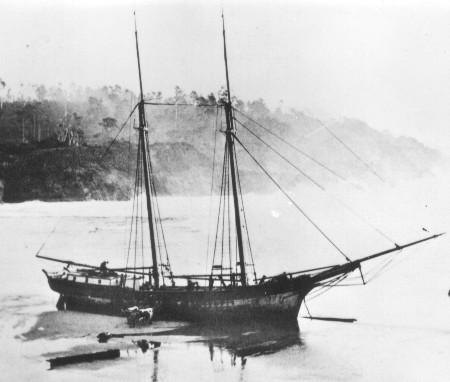
The first part of the solution to the problem came from the design of the ship itself. The early Mendocino timber men used schooners that were shallow drafted, sitting high in the water and moving more surely over the submerged reefs. Because of the narrowness of the hull, however, cargo space was limited.The second part of the solution was to use an “apron chute” or adjustable slide to lower the lumber onto the deck of a ship. This technique is shown in the rare photograph above. Workers on the bluff slid the lumber, piece by piece, down to deck hands who “caught,” packed, and lashed the lumber on the schooner .Sometimes the lumber was slid to a lighter, similar to a log raft, and then transferred to the ship (Jackson, 141). Around 1900, wire and steel cable was used to transfer a large load of lumber onto a ship in one swing.

The photograph below shows the lumber schooner, Ella Florence. The Mendocino Saw MIlls—later the Mendocino Lumber Company—was the owners of the Ella Florence. According to a database of the California State Lands Commission, the Ella Florence was stranded in 1868 off the coast of Mendocino and also parted its moorings there in 1872. The photograph supposedly documents that last incident. This may account for the team of oxen, barely visible in the center of the photo. Perhaps the oxen were there to pull some cargo off the ship resting on the sand.

Author: DMS
Photo Credit
Rockport suspension bridge and rails. Robert J. Lee Collection, Ukiah, Ca.
Primary Source
Rockport Redwood Company Records, BANC MSS 70/184 c, The Bancroft Library (Berkeley, California).
Secondary Source
Mining and Scientific Press (San Francisco), 30 June 1877, Vol. 34, Number 26, p. 420.
Video
Video interview of Bernie Agrons, Rockport Beach, 6 May 2007, conducted by Doris M. Schoenhoff
Photo Credit
Rockport suspension bridge and rails. Robert J. Lee Collection, Ukiah, Ca.
Primary Source
Rockport Redwood Company Records, BANC MSS 70/184 c, The Bancroft Library (Berkeley, California).
Secondary Source
Mining and Scientific Press (San Francisco), 30 June 1877, Vol. 34, Number 26, p. 420.
Video
Video interview of Bernie Agrons, Rockport Beach, 6 May 2007, conducted by Doris M. Schoenhoff

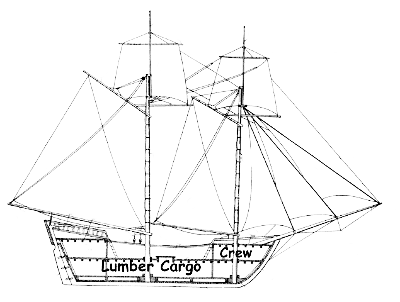
At the San Francisco Maritime National Park, visitors will have an opportunity soon to see one of the old lumber schooners, the C.A. Thayer. Currently being restored, the Thayer was built in 1895 in a northern California shipyard. With a deck length of about 156 ft and a depth of 11.38 ft, the Thayer is typical of the small ships that carried redwood along the northern coast to San Francisco. Her cargo capacity was 575,000 board feet, about the equivalent of ten railroad cars. Manning the ship was generally a crew of about eight or nine men. They lived and slept in the forward part of the bow in conditions that would seem cramped even to an experienced submariner.

Photo Credits
First sawmill from Robert J. Lee Collection (Ukiah).
Lumber schooner photo from Robert J. Lee Collection (Ukiah).
Secondary Sources
Bear, Dorothy and Beth Stebbins. Menodcino: Book Two, Gulf Press: Privately printed, 1977.
Jackson, W. Francis. Big River Was Dammed. Mendocino, CA: FMMC Books, 1991.
Ryder, David Warren. Memories of the Mendocino Coast, San Francisco, CA: Privately Printed, 1948.
Mendocino County Historical Society (MCHS). Mills of Mendocino County: A Record of the Lumber Industry (1852-1996), 1996.
Williams, Edward C. “The First Redwood Operations in California.” Pioneer Western Lumberman 58 (July 1912): 9-13.

The Venture

An editorial in the Mendocino Beacon on May 4, 1878 states that there is “a great detriment to shipping” on the the Pacific Coast because only San Francisco and San Diego had what could be called harbors. During storms along the Mendocino coast, ships lying at coast landings had to put out to sea to avoid being lost. Because of the dangers, ships bound for Mendocino could only come to load 7 or 8 months a year and, even then, they were threatened by unexpected rough weather. According to the shipwreck data base of the California State Lands Commission, there were 160 shipwrecks off the Mendocino coast between 1850-1900. Mendocino Lumber Company, for example, lost the Storm Cloud in 1865, the Brilliant and the Ella Florence in 1872, and the Bobolink in 1898; Caspar Lumber Company fared the same, losing the Cora in 1874, both the Elvenia and Caspar in 1897, and the Jewel in 1899.

The following story, quoted directly from the Mendocino Beacon, April 2, 1892, tells of one ship that met her end at Rockport. Built in 1888, the 127 ft steam schooner, The Venture, was shipwrecked 4 years later. Having dispatched its incoming cargo, including one “venerable Clydesdale,” The Venture, fully loaded with lumber for San Francisco, was caught in rough seas before she could even leave sight of the beach. Eventually the schooner split in two on a rock.

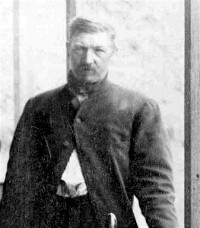
Captain Johnson was a friend to the Gowan family, who were part owners of the Cottoneva Lumber Company and The Venture at this time (Near, p. 70). In fact, Johnson was godfather to one of the Gowan children, Frank.William Gowan (1887-1975). Shortly before his death, Frank reminisced with his niece, Jean Near. He particularly wanted to be sure that the story of the Venture and Captain Johnson was set straight (Near, 161-164). Frank recalled that his father, George Gowan (1843-1927), did not like Johnson and thought he was “cruel, vicious.” Frank says, for example, that “everybody loved the cook” of The Venture, but that Johnson “wanted to kill” him. In one incident, Johnson confronted the cook—apparently drunk—over a jug of whiskey. Johnson pistol-whipped his opponent and ripped open his face with the hammer of his revolver. George Gowan, who Frank adds was “awful mad” about the incident, later got needle and thread to patch up the injured man. The cook would later die in the sea when The Venture met its fatal end with Johnson at her helm. After an investigation and trial, Johnson lost his captain’s license and apparently was never heard of again (Near, 163).

There was a special bond between Frank Gowan and Captain Johnson. Perhaps George Gowan appeared to his son as only a stern, strict father, always busy at the sawmill. Frank, acknowledging his father’s toughness, recalls that George, a longtime cigar smoker, once had a cancer removed from his lip without any anesthetic for the operation, except perhaps a shot of whiskey (Near, 164). Of Johnson, though, the sea captain who gave a little boy his attention and stories, Frank says, “He loved me—no question about it and I loved him—naturally.” He relays how, as a child, he sat on Johnson’s lap and listened to the story of the wreck of The Venture. “Father couldn’t have questioned him,” says Frank. “He wouldn’t have let anyone else ask him. But I was just a baby. I asked him all about it——what happened—and he went through it. I suppose that relieved him. Telling about it. He held me on his lap there and talked to me for an hour or more about what happened.” Another Gowan family member relates that Captain Johnson was “daring” and “threatening” and also “contemptuous of any new gadget” (Near, 453-4). Disparaging barometers, he kept a frog in a glass jar to predict the weather!

In the late 1800s, several of the lumber companies owned one or more ships. Others booked clipper ships and schooners to transport their lumber, primarily to San Francisco. Many of these ships lasted only a few years on the rough coastal seas before being grounded or shipwrecked. The story of The Venture illustrates the dangers and perils of the early logging ventures.

Ashore at Rockport

The Steamer Venture a Total Wreck and Five of the Crew Drowned

Rockport, March 27, 1892

Editor Beacon:

The steamer Venture which arrived last Sunday went ashore this morning and is a total loss. It had been too rough to load during the week but the steamer hauled in Saturday morning and loaded until 7 o’clock in the evening. This morning at 4 o’clock prolonged whistling from the steamer drew attention to the fact that she had parted her head lines, and was drifting on to the beach in a southeasterly direction. A tremendous sea was running and though her engines were driven full speed ahead, she continued to drift and at 5 o’clock struck on a rock which stands almost perpendicular. Up to this time no danger no danger as to the crew had been anticipated, but her boats had been carried away and in launching the life raft, two men— the mate and second engineer—were washed overboard. The mate climbed onto the raft and eventually returned aboard but the second engineer was swept past the vessel and out to sea by the strong undertow. He was seen to struggle awhile in the breakers and then disappear. During this time the vessel was working closer to the bluff, upon seeing which all but the second mate climbed off the vessel onto the rock led by the captain. Shortly after, by 7 o’clock, the vessel broke squarely in two just aft of the hatch, each part floating ashore separately. All but four had now climbed to the top of the bluff, but were unable to make the main land as the descent was too steep. The four men alluded to were the chief engineer, a fireman, a sailor and the cook. Numbed by cold and wet they were unable to ascend the rock and an extra heavy sea washed them from where they clung. The fireman made a desperate effort to swim ashore, but was struck by a piece of floating wreckage and sunk; the others were not seen after being washed off the rock. The most distressing part of the matter was the fact that all this could be seen distinctly by those on the beach, still the the peculiar conformation of the bluff made it impossible to give any assistance. During this time the second mate was still on the after part of the steamer which finally landed firmly on the rock beach some 30 yards north of the place where the others had landed. this enabled the man to come ashore which he very gladly did. The fore part of the steamer, which comprised the hold, came ashore about the same time, scattering lumber and wreckage all around. By this time connection by ropes had been made with the rock on which the balance of the crew—nine in all— were waiting, and by 8 o’clock they were safely ashore. Capt. Johnson states that he was on deck from 12 o’clock on, and that the sea was comparatively smooth until a few minutes before he blew the whistle; but before the lines and cable could be detached and headway gained, she commenced to drift. Those lost are:

— COLLINS, Chief Engineer
— JAS. BURNS, Second Engineer
— WM. STRAND, Fireman
— PETERSON, Sailor
— ANDERSON, Cook

The steamer has about 70,000 feet of pine lumber aboard which is scattered along the beach.

The Venture was a steamer with a capacity of about 320,000 feet, and her managing owner was C.T. Hill of San Francisco. She was insured.

The Venture had been particularly unfortunate of late. On her last trip two of her officers—the mate and second engineer—sustained such injuries as to necessitate their going to the hospital in San Francisco, the mate being sill unconscious when the steamer left the city on her ill-fated trip.

Photo Credits
Rockport suspension bridge with The Venture at sea, Robert J. Lee Collection, Held-Poage Research Library.
Captain Johnson, Robert J. Lee Collection (Ukiah)
Secondary Sources
Mendocino Beacon (April 2, 1892), microfilm, Mendocino Historical Society Held-Poage Research Library, Ukiah, CA.
Jean Helen Gowan Near. A Genealogical Study of the Descendants of Joshua and Anna Gowan. Private printing: The Letter Shop (Ukiah, CA), 1982

Cottoneva Lumber Company

Failure is the opportunity to begin again, more intelligently.
Henry Ford (1863 – 1947)

We all have to decide how we are going to fail.. by not going far enough or by going too far.
Sumner Redstone (1923 – )

W. R. Miller sold his sawmill and timberlands in the winter of 1886. According to a notice in the Mendocino Beacon dated 29 January 1887, an “Eastern syndicate” paid $140,000 for the property. The officers of the newly formed Cottoneva Lumber Company were Joseph Viles (President), H.L. Smith (Vice-President),W. D. McGilvray (Secretary and Treasurer). The company was named after the Cottoneva Creek that ran alongside the sawmill, down to the ocean.

In 1886, Frederick Weyerhauser, who by the end of the 19th century owned more timberland than any other single American, including large forests in Wisconsin, Minnesota, Idaho, Washington, and Oregon, sent George Gowan from his home in Wisconsin to scout out timber mills for sale (Near 54). On February 4, 1886, George wrote from San Francisco to his second wife, LIzzie, who remained in Wisconsin with their children awaiting the birth of their third son less than three weeks later::

If we should live in Mendocino County we would be about as far West as one can get and be in the U.S. The country there is a little colder than here but a good deal the same nature of climate—never very dry and never very cold. It is called healthy by all I have talked with about it (Near, p.58)

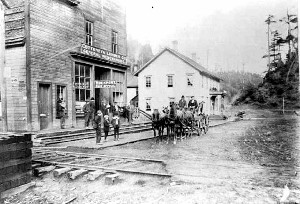
Gowan traveled Mendocino and Sonoma Counties, often on foot. He found a mill for sale in Russian Gulch, Sonoma County, but Weyerhauser was not interested. Hearing opportunity knock,George bought the mill himself and moved his family to California. Profits on the clear redwood proved to be high. Within two years, George and James Gowan decided to buy the controlling interest in the Cottoneva Lumber Company (Near, p. 66). By 1889, George was managing the mill and shipping operations while James oversaw logging and transportation of the logs to the mill. Two other brothers, John and Robert, also joined the mill. Cottoneva Lumber Company employed 200 men and many of their families lived at Rockport. The new town included a hotel, a store, a cookhouse, and a post office.

Over the years, we see various spellings of the name Cottoneva. In a letter to Maria Owen at Rockport Redwood Company, dated 25 April 1966, Victor Golla, of the Department of Linguistics at University of California (Berkeley) wrote about the etymology of the word Cottoneva:

If not Sinkyone, the word would most likely be Coast Yuki. The Yuki language (whence the name Ukiah, by the way) was spoken by several tribes living more or less in a belt across central Mendocino County, directly to the south of the Athabaskans. Rockport, and Cottoneva Creek, were at the northern edge of Coast Yuki territory, which centered at Ten Mile Creek. According to A.L. Kroeber (Handbook of the Indians of California, p. 212) the Coast Yuki called themselves ukohtontilka “ocean people”, from uk-hot “ocean”, literally “water-big”. In the absence of more satisfactory data…on what name, if any, the Coast Yuki gave to Cottoneva Creek, I am tempted to hypothesize that this might have been something like [uk-hot-on-eva], the first elements the same a in uk-hot “ocean”. The Yuki language, sad to say, is very poorly known. (Rockport Redwood Company Records, ctn 19, folder 59-6)

A coast survey of 1878 used the name Cottaneva Creek and the Mendocino County History of 1880 gives Cotineva as an alternate name for Rockport. Historical references to the early sawmills at Rockport sometimes use Cottoneva and Cottaneva interchangeably.

Life in Rockport occasionally had its mishaps even for visitors. The following excerpt from an article in the Mendocino Beacon (July 25, 1891) relays an incident about the mill pond in which logs were floated. In the picture below, the mill pond is on the left.

Mrs. Gray, a San Francisco lady, tried to cross the pond on the logs, the result that she fell in where the water was about twenty feet deep. Frank Hester covered himself with glory and dirty water by promptly taking a header after her and succeeded in getting her safely ashore. He was met shortly afterwards going home singing McGunty.

The Rockport investment ended in a “financial disaster” for the Gowan family (Near, p. 70). When they first embarked on their investment, there were already dire predictions for the lumber industry. Lumber prices in the late 1800s rose and fell. However, initially, things went smoothly. Then, in 1892, The Venture, a lumber schooner that the Cottoneva Lumber Company had purchased from Captain Robert Dollar, one of the largest timber owners in the West, was split in two on the jagged rocks at Rockport. There were bigger headaches to follow. The Depression of 1893 proved to be one of the worst in American history. The unemployment rate exceeded 10% over the next five years. The only other time this occurred in US history was following the stock market crash in 1929. Lumber prices fell. John and Robert Gowan decided to return to Canada in 1893 (Nea 74). In November and December of that same year, George was spending most of his time in San Francisco on legal matters surrounding the lumber company, clearly trying to pull out. He wrote to his wife, Lizzie at Rockport on December 7, 1893:

If the managers of the Cottoneva Lumber Co. are trying to be disagreeable we will only have to push our accounts and collect and get away from Rockport. I am not of the opinion they they will dare to be very hostile until they have the money to pay what is due. So far they have been asking for us to be lenient with them and I hope everything will go smoothly. (Near 76)

On June 23, 1895, arbitration was found in favor of George Gowan, and Joseph Viles was ordered to pay him $9229 within the year (Near 78). By early 1894, George had moved his family from Rockport to a farm in Sherwood Valley where he tried cattle ranching (Near 79). Several years later he would move again to Anderson Valley to raise hops. Many of the Gowan family remain in Anderson Valley today, known for their orchards and produce stands.

The sawmill at the Cottoneva Lumber Company burned in 1900. Around 1907, the Dusenbury family of Olean, New York, who owned the New York and Pennsylvania Redwood Company, acquired Cottoneva Lumber Company. They planned to build a new mill at Rockport but their plans never materialized.

Photo Credits
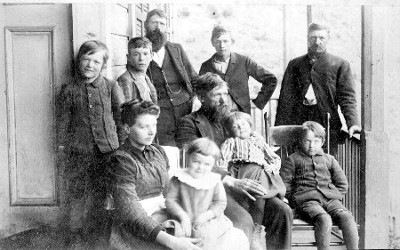
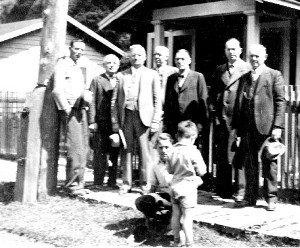
Gowan Family c. 1890-2, Robert J. Lee Collection (Ukiah).
Back row (l-to-r) Byron, Hiram, Uncle Jim, Lester (Jim’s boy), and Capt. Johnson of The Venture
Front Row (l-to-r) Mrs. Gowan, Cecil (on lap), Mr. George Gowan, Frank (on lap), and Jud
Miller sawmill, Robert J. Lee Collection (Ukiah)
Cottoneva Hotel, c. 1896 Rober J. Lee Collection, Held-Poage Research LIbrary
Cottoneva Lumber Co. Office, c.1899, Robert J. Lee Collection, Held Poage Research LIbrary
Cottoneva Locomotive, c. 1897, Robert Lee Collection, Held Poage Research LIbrary.
Dusenbury Family, Robert Lee Collection, Held Poage Research LIbrary.
Primary Sources
Rockport Redwood Company Records, BANC MSS 70/184 c, The Bancroft Library (Berkeley, California).
Secondary Sources
Jean Helen Gowan Near. A Genealogical Study of the Descendants of Joshus and Anna Gowan. Private printing: The Letter Shop (Ukiah, CA), 1982.

Finkbine-Guild Company

The four most dangerous words in investing are “This time it’s different.”
Sir John Templeton (1912 – )

Finkbine-Guild Lumber Company (1925-1927) had made ambitious plans for Rockport. A copy of a preliminary report from their title insurance company, dated September 1, 1925, states that Finkbine-Guild is seeking a loan for $2,225,000 “to complete the purchase of timberlands and for the building of a manufacturing plant at Rockport, California” (Rockport Records, ctn 4, folder 7-1). This sizable mortgage was to be secured by “approximately 29,278.60 acres estimated by James D. Lacey and Company to carry virgin timber in the amount of 1,080,344,000 feet, of which 84% is redwood, and 16% Douglas fir and by sawmills, loading facilities, dwellings and other operating improvements now being placed on the lands at a cost of more than $1,000,000” (ibid). A deed of trust required re-payment of the loan in ten installments of $225,000 plus interest, beginning September 1, 1927 and ending September 1, 1936.

Finkbine-Guild had been successful at operating southern pine mills in Mississippi. After exhaustion of their Mississippi timberlands, they planned to keep their mills as re-manufacturing and finishing plants and feed them with California redwood.With headquarters in Jackson, Mississippi, the Finkbine-Guild Lumber Company bought the Cottoneva Lumber Company, dormant for 15 years, in 1925. The officers of the company at that time were W. E. Guild, president; W. O. Finkbine, vice-president; R. H. Finkbine, vice-president; H. M. Finkbine, vice-president; R. G. Berry, treasurer; and C. E. Klumb, Secretary.

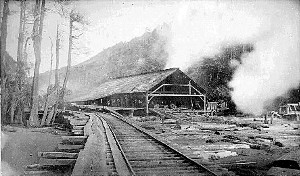
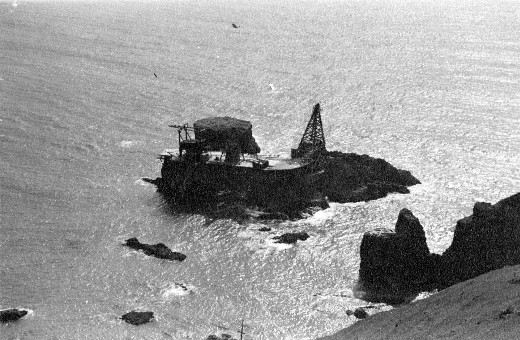
The new owners constructed a sawmill, logging railroads, and loading facilities, including redwood towers and a cable system, powered by a steam engine, to sling logs from shore to the “island rock” and then onto ships—the Frank B. Stout, the Bertie M. Hanlon, the Florence Olson, and the Necanicum. Because of the remote location, Finkbine-Guild built the first modern family homes at Rockport and introduced many new services, including a company store, a mess hall, a hotel, a barber shop, and an emergency hospital with a doctor in attendance. Since 35 families were now living at Rockport, there was also a school with two teachers for the 60 children registered to attend. One of the teachers was Miss DeVilbiss, a well-known family name at that time in the Rockport area. Benefits for the sawmill workers, however, did not necessarily include national holidays. A notation in the Finkbine-Guild files from Joe Alexander, the company general manager, says: “Did not shut down for Thanksgiving, but I am giving the crews a turkey dinner tonight” (Rockport Records, ctn 19, folder 59-27, research paper presumably by Edgar L. Stetson from Sacramento State College on Finkbine-Guild Lumber Company, p. 18).

In an age before email, faxes, and even reliable phone lines, W. E. Guild, company president, and Joe Alexander exchanged letters daily. Were someone to analyze those letters, we would have an excellent picture of the day-to-day workings of the company and the difficulties a manager had coping with the problems of a remote location and remote company executives. Daily problems included broken turbines, broken cable lines, bad weather, blocked roads, difficulties in getting materials and groceries, and, of course, labor issues. Guild usually addressed Alexander as “Dear Joe” or just “Friend Joe.” Guild writes to Alexander on 20 January 1927, blaming his delayed response on endless meetings and encouraging Alexander to keep the lumber schooners sailing on schedule:

All the redwood logged at Rockport was destined for Gulfport, Mississippi. Finkbine-Guild spent considerable money building a dock and loading facilities in San Francisco Bay near Sausalito. From there, logs would be transferred to one of the company’s oil-burning ships: the Abron, Dochet, Manhattan Island, Sabatowan, and Dio ((Rockport Records, ctn 19, folder 59-27, Finkbine-Guild Lumber Company, p. 13 -14). Four were purchased on November 20, 1925 and the last on February 10, 1926 (ibid). Together they were called The Redwood Line. The ships steamed from San Francisco Bay through the Panama Canal to Gulport, Mississippi. At Gulfport, the ships were unloaded and logs were put onto railroad flat cars for the trip to D’Lo, Mississippi. It was at D’Lo that the logs were processed into finished lumber. Rockport mill only produced cants—unbarked logs that are roughly cut into several pieces for later re-manufacturing. There were no planers to produce finished lumber. According to one researcher with access to the Finkbine-Guild records, the sawmill at D’Lo received 12,344, 022 board feet of lumber during the first 9 months of 1927—less than anticipated (ibid, p. 15). In 1927, redwood lumber prices at D’Lo ranged from $45-$100 per 1000 board feet (ibid).

Money and technology do not guarantee success, as any CEO or general can attest. The opportunities for project failure are legion. By 1927, nothing could stop the corporate bleeding at Finkbine Guild, including a top-level shakeup that resulted in E. C. Finkbine as president; W. O. Finkbine, vice-president; and W. E. Guild, treasurer and general manager. Within two years of operation, the Finkbine-Guild Lumber Company was broke. Despite the fact that Finkbine-Guild Lumber Company was the first electric-powered sawmill in Mendocino County—the most technologically innovative sawmill on the Redwood Coast—it has been called a “magnificent failure” (Rockport Records, ctn 19, folder 58-24, Letter of Bernie Agrons to Elwood R. Maunder, Foest History Society, 12 August 1963). The ultimate failure of Finkbine-Guild is a lesson in Business 101 and the bottom line. They could not compete because they were bearing extra handling costs that local redwood companies did not have.

From here on out, the story of Finkbine-Guild becomes more complicated. A letter from the Mendocino County Title Company on December 30, 1929 confirms that all the lands acquired by Finkbine-Guild were deeded to Southern Redwood Company on July 1, 1928 (Rockport Records,ctn 4, folder 7-1). The arrangement between Finkbine-Guild and Southern Redwood Company has been called variously a “re-organization” and a “merger” to continue operations at Rockport. Documents do show that Southern Redwood Company took out a second mortgage on the Rockport property from Great Southern Lumber Company on August 27, 1929. Whatever the relationship between Finkbine-Guild and Southern Redwood Company was, Finkbine-Guild ended it when they defaulted on the Rockport property’s first mortgage on September 1, 1929. The total amount of the obligation had been $2,225,000. Prior to the default, $450,000 had been paid, leaving the default at $1,800,000 (Rockport Records, ctn 19, folder 59-30, “Cottoneva Redwood Company” Prospectus). In Case #11508 before the Superior Court of the State of California, E. T. Dusenbury, as trustee of Cottoneva Lumber Company, foreclosed on the Finkbine-Guild mortgage on May 1, 1931. On January 14, 1933, Dusenbury transferred title of the property to the newly chartered Cottaneva Redwood Company (Rockport Records, ctn 19, folder 59-30, “Cottoneva Redwood Company” Prospectus).

Photo Credits
Rockport towers (1925), Robert J. Lee Collection (Ukiah, CA).
Rockport rail line and lumber “sling”, Robert J. Lee Collection (Ukiah, CA).
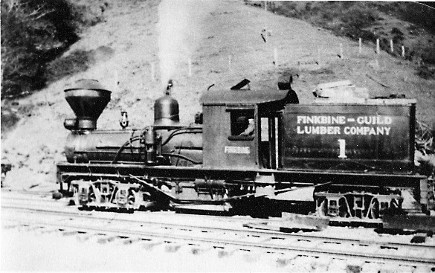
Finkbine-Guild Shay Engine #1, Mendocino County Museum (Willits, CA).
Primary Sources
Rockport Redwood Company Records, BANC MSS 70/184 c, The Bancroft Library (Berkeley, California).

Southern Redwood Company

If at first you don’t succeed, try, try, try again.
W. E. Hickson (1803 – 1870)

The successor to the Finkbine-Guild Lumber Company was the Southern Redwood Company (1928-1929). Very little is known of this part of Rockport history. We do know that Southern Redwood had ties to the Goodyear family, both in Buffalo, New York and Bogalusa, Louisiana. In 1887, Charles W. Goodyear (1846 – 1911) banded together with his brother Frank H. (1849 – 1907) to form what eventually would be called the Goodyear Lumber Company. The brothers, C. W. and F. H., who owned vast forests of hemlock in Pennsylvania, were considered prominent lumber barons of the Gay Nineties, with mansions on “Millionaires’ Row” in Buffalo and powerful friends like Grover Cleveland, Governor of New York and later the only President of the United States to serve two non-consecutive terms (1885–1889 and 1893–1897). The Goodyears made their money during a period when there was no minimum wage and no income tax. The U.S. Congress had enacted the nation’s first income tax law in 1862 to support the Civil War. They eliminated the income tax in 1872 and it was only the 16th Amendment to the Constitution that permanently re-instated it in 1913.

When their forests in Pennsylvania were exhausted, the middle-aged Goodyear brothers, C. W. at 56 and F. H. at 52, bought up thousands of acres of long leaf virgin pine in Louisiana. The tract of virgin timber was a “triangular area running approximately seventy miles east and west and extending north one hundred and thirty miles” (Goodyear 127). Eventually they founded the town of Bogalusa, Louisiana in 1906 when they erected a sawmill on the Bogue Lusa (Dark Waters) Creek. From this start-up operation emerged the Great Southern Lumber Company (1908-1938), reportedly the largest sawmill in the world until it ceased operations. In 1950, C. W. II wrote the story of Bogalusa and the company that his father and uncle had built. The land they purchased had originally belonged to the Choctaw Indians, who had been relegated to a reservation in Oklahoma. This, of course, was a story repeated over and over again in 19th century American history. Chief Joseph (1840-1904) of the Nez Perce, who also saw his people sent to a reservation in Oklahoma where many died of malaria and starvation, was eloquent in speaking about the difference between his people and the white men who displaced them on the earth:

I have carried a heavy load on my back ever since I was a boy. I realized then that we could not hold our own with the white men. We were like deer. They were like grizzly bears. We had a small country. Their country was large. We were contented to let things remain as the Great Spirit Chief made them. They were not, and would change the rivers and mountains if they did not suit them.

As if to prove Chief Joseph’s point, C. W. II recounts the forest story through white men’s eyes as wilderness would soon give way to a sawmill, houses, businesses, churches, saloons, and a brand new town. “Choctaw Indians, hostile and shrewd,” writes Goodyear, “had guarded it long and well and, they left it as they had found it—a forest wilderness of magnificent expanse, its riches waiting to be tapped” (Goodyear 1). The Goodyears definitely had their tap shoes on and their act did not include leaving the land as they had found it. Like many Americans of their generation, they saw the land in terms of conquest and exploitation. This, of course, was long before forest science and forest management saw their way into university curricula, long before timber harvest plans and habitat conservation plans. Moreover, the Goodyear brothers had not mellowed with age and wealth. “Making money from the production of lumber was still in their blood,” Goodyear explains. “So they carried on in Louisiana what they had started in Pennsylvania, but on an even greater scale” (Goodyear 69). Neither of the brothers actually lived to see the so-called “Magic City” that their sawmill had created. In earliest days, however, it seems to have resembled not so much the Magic Kingdom as Dodge City and the Wild West. “Revolver shots were often exchanged and sometimes there were ‘killins’, ” writes Goodyear. “The lynching of a Negro, who perhaps was innocent of any wrongdoing, caused greater tenseness in the relations between the whites and colored. Bogalusa became ‘the toughest town in the country” (Goodyear 83).

Two of C. W.’s sons, Yale graduates, carried on the next phase of the Goodyear lumber business. It was then that the story of Bogalusa and that of Rockport intersects. On July 1 1928, all of the lands and timber owned by Finkbine-Guild Company were deeded to Southern Redwood Company (Rockport Records, ctn 4, folder 7-1). Anson Conger (1877 – 1964) and C.W II (1883 -1967) were installed as president and vice-president of Southern Redwood. Southern Redwood took out a second mortgage on the Rockport property through Great Southern Lumber Company. Cottoneva Lumber Company, however, still held the original deed of trust and Finkbine-Guild’s first mortgage on that same property. Whatever the Goodyear plan for the mill at Rockport was, it did not work. Southern Redwood was staring not just the Finkbine-Guild creditors in the face but something much bigger—the Great Depression. Like the national economy as a whole, the timber and lumber industries started spiraling downward. Housing construction stalled, mills closed, and mill workers joined the new class of unemployed Americans, often homeless and transient. Eventually E. T. Dusenbury, the trustee for Cottoneva Lumber Company, foreclosed on the Rockport property. E. C. Cronwall was a friend of the Dusenbury’s and apparently brokered the original deal between them and Finkbine-Guild. “I never did know, nor could I learn,” Cronwall writes in a letter dated 14 February 1945, “just what the arrangement was between the Southern Redwood Company and the Finkbine-Guild Company, but whatever this arrangement was, as so far as it concerned the Rockport plant and timberlands, was all subject to the Finkbine-Guild Lumber Company bonds, and when the mortgage securing those bonds was foreclosed it, of course, wiped out the equity of the Southern Redwood Company as well as that of Finkbine-Guild Lumber Company” (Rockport Records, ctn 4, folder 7-1).
.

Primary Source
Rockport Redwood Company Records, BANC MSS 70/184c, The Bancroft Library (Berkeley, CA).
Secondary Source
Goodyear II, Charles W. Bogalusa Story. Buffalo, New York: Privately Printed, 1950. Transcribed for the Web by Patricia Darlene McClendon (© 2002).

Cottoneva Redwood Company

Creditors have better memories than debtors; and creditors are a superstitious sect, great observers of set days and times.
Benjamin Franklin (1706 – 1790)

If you think nobody cares if you’re alive, try missing a couple of car payments..
Earl Wilson (1907 – 1987)

After two company failures in a row—Finkbine-Guild Company and Southern Redwood Company—and a mill that had been idle for four years, the Rockport property creditors, with E. T. Dusenbury as trustee, finally foreclosed on the Finkbine-Guild mortgage and on January 14, 1933 transferred title of the property to the newly chartered Cottaneva Redwood Company (Rockport Records, ctn 19, folder 59-30, “Cottoneva Redwood Company” Prospectus). The Cottoneva Redwood Company would never saw a log of timber. The intent of the charter was to clear existing debts and put out the lawn sign: FOR SALE.

Primary Sources
Rockport Redwood Company Records, BANC MSS 70/184c, The Bancroft Library (Berkeley, CA).

Rockport Redwood Company

In my end is my beginning.
T. S. Eliot (1888-1965)

Towns come and go and we are the fourth company to have operated here—but the land is eternal.
Bernard Z. Agrons (1920 – )

If you want a happy ending, that depends, of course, on where you stop your story.
Orson Welles (1915-1985)

Hollywood learned long ago that Americans love a comeback story. While it probably will never find its way onto the big screen like Seabiscuit, the tale of Rockport Redwood Company has its own human drama of loss and return. At the center of the story is a wealthy family and a small company town on a rugged, isolated coastline. Ambitions and struggles are set against the backdrop of three major developments of 20th century history—The Great Depression (1929-1940), World War II (1939-1945), and Post War American Culture (1945-1960).

As often happens, failed businesses are opportunities for other entrepreneurs. “Opportunity is missed by most,” Thomas Edison said, “because it is dressed in overalls and looks like work.” After two company failures in a row and a mill that had been idle for four years, the property creditors, with E. T. Dusenbury as trustee, finally foreclosed on the Finkbine-Guild mortgage and on January 14, 1933 transferred title of the property to the newly chartered Cottaneva Redwood Company (Rockport Records, ctn 19, folder 59). Another four years passed. So did E. T. Dusenbury, who died on January 30, 1937 of asthma (MB, Vol. LIX, no. 19, 6 February 1937, p.1). The mill continued to sit empty and rusting and its owners were anxious to strike a deal. Along came Ralph M. Rounds—a midwestern lumberman.

Born in Alliance, Nebraska on January 22, 1891, Rounds was the only son of Dwight C. Rounds. His father, president of Rounds and Porter Lumber Company, operated retail lumber yards in Kansas, Oklahoma, and Texas. Rounds graduated from Stanford University in 1913 with a degree in history from the School of Humanities and Sciences. At the age of 30 he married Rebecca Cooper in Wichita, Kansas and raised two sons there. Ralph Cooper, who would go by the name of Bill, was born on August 17, 1923; Dwight Merle, on May 15, 1926.

The Rounds patriarch died at his home in Hollywood, California in 1938. That was the year that his son Ralph would expand operations to California redwood country. The 46-year-old entrepreneur unexpectedly saw a sweet deal beckoning in Rockport, California. Frank Kilpatrick, vice-president of Rockport Redwood Company, recalled in 1963 an early conversation with Rounds:

Mr. Rounds once told me how he came to purchase Rockport and he said that he had not really been looking for that sort of an investment when he came across it but he made such a good deal he could not turn it down. The owners offered to sell Ralph Rockport for $400,000. He was to pay for the stock and the money went into the corporation and this would furnish the money with which to operate—little did he know then how much it was going to take to get the thing going. (Rockport Records, ctn 19, folder 59)

Prior to the Rockport sale, Rounds was given a walk through a part of the forest. At the time, walking was the only way to get in and out. Kilpatrick suggests in his 1963 recollection that the spot selected, Middle Creek, was not typical of the property as a whole and that later inspections would fall short of Rounds’ expectations. If this was the case, it was not unusual in property sales then or now. In any event, Kilpatrick’s memory proved accurate; a letter sent from Rounds in Wichita to Kilpatrick at the San Francisco office, dated 6 June 1950, states his disappointment:

You ask me how much timber I thought we had when we first purchased Rockport. At that time, I thought we had approximately one billion feet of standing timber there . . . I know that Mr. Dusenbury was very disappointed, when I saw him a few years after we had taken over the operation, to learn from me that we were not going to get the billion feet we had hoped to get. I cannot tell you what Mr. Ed Dusenbury thought about the timber when he bid in the property in 1932 or 1933, but I do know he considered the Hollow Tree tract an unusually heavy stand of good quality timber and, if he were still alive, I know he would feel as disappointed about it as we do. (Rockport Records, ctn 19, folder 59)

Since foresight is not as common as hindsight, Rounds and his associates took the lease in 1937 on the Cottoneva Redwood Company with an option to buy. In a proposal letter dated and accepted on 17 December 1937, Rounds agreed to pay Cottoneva Redwood Company $1 per thousand feet of lumber sawed at the mill to lease the mill, the logging railroad and equipment, and the houses (Rockport Records, ctn 19, folder 59-30). In cutting and removing timber, Rounds would pay $2 per thousand feet of logs, measured at the log deck (ibid). Rounds also agreed to pay the current real estate and personal taxes of $7,238.31, to pay the installment on the delinquent taxes, and to pay the current insurance premium of $5,562.12 (ibid). Logging and milling began the following year in Rockport around the first of April (MB, Vol. LX, no. 16, 15 January 1938, p.1). Exercising his option in 1941, Rounds and his associates purchased the Cottoneva Redwood Company and changed its name to the Rockport Redwood Company. Operations at that time included a sawmill, a company town, and approximately 30,000 acres of timberland.

Initially, Rockport Redwood Company used the logging and milling equipment from the Finkbine-Guild operation, including four Shay locomotives and a Lawson Flyer. A letter dated 1 January 1926 from J. D. Alexander, the manager for Finkbine-Guild, indicates that Shay Locomotive No. 1 had originally been shipped to Rockport at a cost of $1,872.94 (Rockport Records, ctn 19, folder 58-23). Ralph Rounds even resurrected one of the old towers built by Finkbine-Guild. When Finkbine-Guild was operating, there was a large tower on the mainland and a smaller tower on an offshore rock. Between the towers was a cable system powered by a Lidgerwood engine that transported the lumber from the mainland to the rock. When Rounds acquired the Rockport property, the large tower remained, although in disrepair, but the smaller one was gone (Rockport Records, ctn 19, folder 59). Rounds, at considerable expense, overhauled the tower and cable system and loaded one shipment of lumber on a schooner. All this effort was actually a ploy to exact “reasonable” hauling rates from the truckers who were reluctant to make the trip to Rockport. Rounds proved to the truckers that, if push came to shove, he could get his lumber to market the old-fashioned way—by sea. The truckers negotiated. By 1940 all wood operations in the Rockport forest were carried out by tractor and truck. Moreover, all lumber produced at Rockport was sold to the Rounds Lumber Company and sent to the 45-acre Rounds plant 3 miles south of Cloverdale on Highway 101. Rockport Redwood Company itself had no sales organization. The Rounds Lumber Company sold the Rockport lumber to retail lumber dealers in northern California and to lumber wholesalers in other parts of the country (Rockport Records, ctn 19, folder 59-30).

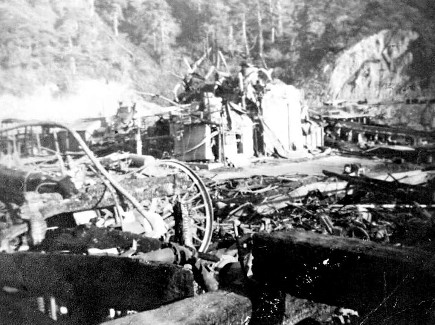
Sawmills have always been susceptible to fires and there were a succession of fires at the various Rockport mills over the years. In 1942, the mill at Rockport Redwood Company was added to that list. The mill fire occurred shortly after 5:30 a.m. on Tuesday, September 8. Fortunately, all the lumber on hand, approximately 5-6 million board feet, were saved (MB, Vol. LXIII, no. 50, 12 September 1942, p.1). The company leased a small mill at Juan Creek while the Rockport mill was rebuilt (MB, Vol. LXV, no. 5, 31 October 1942). Rounds faced other obstacles besides the fire itself. With World War II in full swing, many items were rationed or impossible to get. In a speech on April 28, 1942, President Franklin Roosevelt (1882-1945) rallied Americans to sacrifice for the war effort:

As we here at home contemplate our own duties, our own responsibilities, let us think and think hard of the example which is being set for us by our fighting men. Our soldiers and sailors are members of well-disciplined units. But they’re still and forever individuals, free individuals. They are farmers and workers, businessmen, professional men, artists, clerks. They are the United States of America. That is why they fight. We too are the United States of America. That is why we must work and sacrifice. It is for them. It is for us. It is for victory.

Franklin D. Roosevelet

The U.S. military had first claim on aluminum, steel, rubber, machine parts, and gasoline, as well as items like coffee, sugar, and cigarettes. In salvaging drives, small-town America gathered together rubber tires and rubber duckies, tin cans, bottles, and even women’s silk and nylon hosiery for parachutes. This was America’s first taste of re-cycling. While ordinary Americans felt the pinch, so did American businesses. Rockport mill was just one of many during the war years that had to be rebuilt with used parts.War meant not just a scarcity of parts but a scarcity of labor as well. Kilpatrick spoke of this years later:

We had great difficulties during the war keeping men. We had two men in Sacramento – man catchers with [a} pick up truck bringing men back and forth. The men usually brought a jug of wine and worked 2 or 3 days and we would have to send them back. Jack Mitchell was a man catcher. He would load up in Los Angeles in a 7 passenger car and drive across country. We were able to get gasoline to import the workers from Los Angeles. We recruited them from Sacramento, quite a few from Los Angeles and Atoka, Oklahoma and the Atoka people turned out quite well – better than Los Angeles. The Oklahoma people were good people. (Rockport Records, ctn 19, folder 59)

Rounds also experienced the war in more personal and profound ways than just scrounging for mill parts or hiring workers. While the 53-year old Rounds looked after business, his 20-year old son, Bill, went to war on a B-24 bomber crew.

A different strife came on the heels of the war. Rockport mill, like others in northern California, was halted by a worker strike. The strike lasted a total of 818 days, from January 14, 1946 to April 11, 1948. Kilpatrick recounted in 1963 the effect of the strike on Rockport Redwood Company:

In 1947 we had the strike that lasted 27 months. We were down about six months and finally decided, along with the other mill owners, to start up so we had a little mill down there and so we filed the saws with very heavy gauge to make a lot of noise and started up the mill. So the pickets out there could hear the mill running and did not know whether we were cutting lumber or what but we were cutting up slabs. So the first day we operate with 12 or 15 men coming in and the second day only 6 or 7 came in and we thought we were blown up and I remember these figures because it was such a critical time and the next day about 20 men came in. From there we were off to the races with our men going through the picket lines and a lot of our people tore up the union cards and threw them in the faces of the pickets. We never had a union since. About that time some of the other mills started to break the strike and all started the same time. We took a wagonload of provisions around to the people and we had some terrible battles among the people there – those in favor of the strike and those who were not. Much hard feeling at the time. We had a bad time collecting the rent from strikers but we finally did get some [and] forgave a lot, too. A lot went through the picket line who had belonged to the union before. We have had four or five elections at Rockport. (Rockport Records, ctn 19, folder 59)

There is some evidence that Ralph Rounds, having faced a number of disappointments and challenges with the Rockport property right from the start, was considering putting the 30,000 acres up for sale. In a note to Kilpatrick scribbled on a prospectus prepared by Cottoneva Redwood Company and given to Ralph Rounds in December 1937 as he pondered the lease-to-buy deal that was being offered to him, Rounds wrote:

K.

This prospectus helped sell Rockport to me. Maybe we can get up one to sell to a willing buyer.

R. 12/6/48

(Rockport Records, ctn 19, folder 59-30)

While managing to limp along into the 1950s, even purchasing a Helio Courier at one point, Rockport Redwood Company finally fell to competition and inefficient technology. Toward the end, they were, as companies before them, simply liquidating the timber stock (Agrons interview). In 1955, Kilpatrick described the land as “approximately 12,000 acres in virgin timberland, approximately 16,000 acres cut over land, and approximately 2,000 acres of grassland” and added that “some of the cut over land was logged 20-30-40 years ago and the rest logged by this company” (Rockport Records, ctn 19, folder 59-30, letter of F.C. Kilpatrick, 12 April 1955). While the company was still engaging in clear cutting, Kilpatrick notes that most of the current logging was “on a selective basis, leaving the smaller trees” (ibid). Ralph Rounds, in a letter to Kilpatrick on 17 September 1957, finally confirmed the decision to call it quits:

I think the longer we put off the closing of our Rockport sawmill, the greater will be our financial loss; and so I think we reached a good decision this afternoon, when we decided to “blow the whistle” on October 1st. (Rockport Records, ctn 17, folder 54-14)

With the mill closed, the owners began re-seeding the cut-over forest and proceeded to take a closer inventory of their biggest asset, namely the land and the remaining virgin timber. They also took stock of the logs that remained at the mill. L. I. Holmes, the Vice-President and General Manager at Rockport at the time of the mill closure, wrote to F. C. Kilpatrick on February 10, 1958:

We have approximately

4,000,000 FBM redwood logs
2,500,00 FBM fir logs

on hand at Rockport. It can be estimated that 70 percent of this volume, both in redwood and fir, is in logs 30 inches and less in diameter. This means that we have 4,000,000 FBM useable in our Gang Mill. (Rockport Records, ctn 17, folder 54-14)

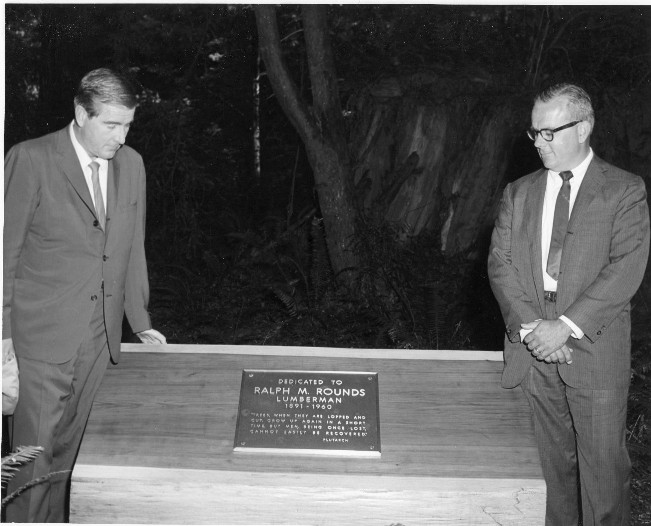
Events would take another turn after Ralph M. Rounds’ death on July 23, 1960 in Taos, New Mexico at the age of 69 (Wichita Eagle, 24 July 1960, p. 5A). That same year, the Rockport Redwood Company certified its timberlands as the Ralph M. Rounds Tree Farm, selling timber to neighboring companies. The term “tree farm” originated two decades earlier in the 1940s, as the timber industry introduced the concept of sustainable forestry and continual stewardship. Farming implies continuous nurturing and commitment to a “crop” year after year. Tree farming was the polar opposite of the “cut-out and get-out” strategy of some timber industrialists. On August 25, 1965, Rockport Redwood Company, with Carl Nelson now as president, dedicated their Demonstration Forest, only the third such forest in a chain to be developed in the redwood region and the first in Mendocino County (Rockport Records, ctn 3, folder 3-18). It was to be an outdoor classroom for the public to learn about the ecology of a second-growth redwood forest. Today it is on the northern edge of MRC land and serves as a picnic area and walking trail. A bronze plaque to Ralph M. Round, however, is still in place.

In the final years of Rockport Redwood Company, Bernard Z. Agrons was given the task of managing the inventory crews and proposing a management plan for the Rockport timberlands. The plan called for a moratorium on harvesting with only a light selective cut in 15 years and culling of defective trees and some mature second growth trees to allow growing space for new vigorous trees. This plan was never carried out. The heir to the Rockport property was one of Ralph Rounds’ sons, Bill. Bill finally sold the Ralph M. Rounds Tree Farm and the town of Rockport to Georgia-Pacific on July 30, 1968. In 1973 the Rounds Tree Farm, the Georgia-Pacific timberlands throughout northern California, and the former town of Rockport was spun off into Louisiana-Pacific. MRC purchased the Louisiana-Pacific lands, including the Rockport town site, in 1998.

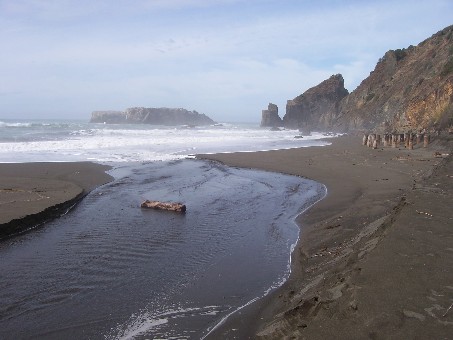
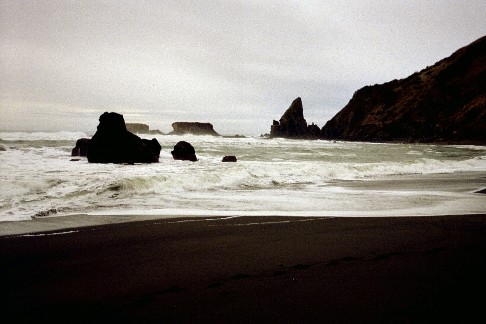
Rockport Redwood Company presided over the end of an era on this northernmost slice of Mendocino coast. Under its watch, the last mill since milling operations first began at Rockport in 1877 was closed. With the passage of another 50 years, nature and new land managers reclaimed the land, leaving only a slight reminder here and there of the mill and the town of Rockport. Today Rockport beach is one of the most beautiful in northern California. While it remains a private beach, many guests and organizations from the local community enjoy it throughout the year for camping and picnics.

Photo Credits
Rockport Mill and Rockport Mill Fire, Robert J. Lee Collection, Held-Poage Research Library (Ukiah, CA).
Rockport Beach, color/BW (2005), Doris M. Schoenhoff (MRC).
Primary Sources
Agrons, Bernie. Video interviews at Rockport Beach and Rockport Guest House, 6 May 2007, conducted by Doris M. Schoenhoff (MRC).
Rockport Redwood Company Records, BANC MSS 70/184c, The Bancroft Library (Berkeley, CA).
Posters
Defense Needs Rubber, 1941, U.S. Office for Emergency Management, in collection of Northwestern University Library (Chicago, IL).
Do with Less, 1943, U.S. Office of War Information, in collection of Northwestern University Library (Chicago, IL)..

Rockport Video Library


All of the books in the world contain no more information than is broadcast as video in a single large American city in a single year. Not all bits have equal value.
Carl Sagan (1934 -1996)

Words and pictures can work together to communicate more powerfully than either alone.
William Albert Allard (1937 – )

Each person is a living history book. Oral history is a way of collecting and preserving personal memories and experiences. Historians have a need not simply to understand the great events and powerful figures in a decade or a century, but to understand the ordinary, day-to-day lives of us all. In fact, for most of humanity’s time on planet earth, oral transmission has been the only way that history and all knowledge and experience passed from one person to another, one generation to the next.

Bernie Agrons, who became the last V.P. and General Manager of Rockport Redwood Company in 1966, originally moved to Rockport in 1956 from Pacific Lumber Company in Scotia, California, and remained until approximately 1969. After leaving Rockport, Bernie eventually took a position with Weyerhauser, becoming in a few years the timberlands manager of a 650,000 acre forest in North Carolina. Later he was transferred to Klamath Falls, Oregon and became Vice President of Weyerhauser’s Eastern Oregon Region, overseeing a 630,000 acre tract of pine forest. Now retired from both Weyerhauser and the Oregon legislature, Bernie returned to Rockport in 2007 to re-visit his old home, converted to an MRC guest house, and reminisce about life at Rockport in the final years of company operations. With him was his daughter, Judy Bergstrom, who came to Rockport as an adopted 1-month-old infant in January 1958 and moved away with her family when she was about 11 years old.

Most of the video clips provided here are about life at Rockport in the 1950s and 60s. In two of the clips, Whittler’s Bench and Cottoneva Stream, Bernie is walking through the Honky Tonk Picnic Area at Rockport, a former demonstration forest that he himself started, and commenting on things along the trail. Simply click on a video title to view the clip. For those who may not have high speed DSL or cable connections, the files sizes are indicated.

Last Days at the Mill
Town Of Rockport
Rockport Community
Honky Tonk Saloon
Milton and the Sheep Dogs
Ralph Rounds' Towers
A Place for Kids
Rockport Childhood
Renters and Mario Savio
Whittler's Bench
Cottoneva Stream
Windy and the Quail

The Redwood Wars

The 150-year old redwood industry occupies a narrow strip of land 200 miles long and about 40 miles wide along the rugged northern California coast. In January 14, 1946, that industry was rocked to its core—not by an earthquake but by one of the longest work strikes in our nation’s history.

Eight redwood lumber companies— Pacific Lumber (Scotia), Union Lumber (Fort Bragg), Caspar Lumber (Caspar), Northern Redwood Lumber Company (Korbel), Rockport Redwood Company (Rockport), Arcata Redwood Company (Arcata), Holmes Eureka Lumber Company (Eureka), Hammond Lumber Company (Eureka), and Dolbeer and Carson Lumber Company—were affected. Hollow Tree Lumber Company, which later became part of Louisiana-Pacific and then Mendocino Redwood Company, was not affected by the strike.The strike continued for about 27 months. At issue was the AFL Lumber and Sawmill Workers Union demand for a wage increase from 82.5¢ an hour to $1.05 for the workers, as well as for a closed union shop. It was a bitter dispute that pitted not only companies against employees but, in some cases, neighbors against neighbors.

At Pacific Lumber Company in Scotia, 42 World War II veterans broke through the union line and went to work. “Not long ago, we were called heroes,” their spokesman said, ” Now we are called scabs and company rats because we want to get off the government dole and earn a living…Not only do we want to go back to work. Veterans all over the country are begging for places to live. Lumber is needed for houses. We intend to see that the veteran gets it” (Humboldt Times, 11 August 1946).

Stephen Fischer, a staff writer for the San Francisco Chronicle, wrote about the effect of the strike on a typical sawmill town— Rockport:

San Francisco Chronicle
February 8, 1948
Except for a very few men, those who live in the Rockport Redwood Company’s town work for the company. Those few who continue to live in Rockport but no longer work for the company are intimately associated with its operations.
For more than two years those men have paced before the entrance to the company’s property carrying signs which announce the AFL Lumber and Sawmill Workers on strike. At eight other redwood companies, some larger and some smaller than Rockport, pickets carry similar signs as the longest major strike in the nation’s history continues.

The strike involves only 4000 men, not a very large number when compared to the giant industry-wide tie-ups which have periodically shut down steel and coal and shipping. But the redwood strike is important because of its length and what it has done to the industry and the people involved.

The strike has turned old friends, men who worked long years together, wrestling with the world’s greatest trees, into bitter enemies. It has created a deep and bitter cleft among one-time clsoe business associates. It has forced families to move from home they had considered their lifetimes residences.

After struggling against each other for more than two years in the deep, lonesome woods, some men have grown weary. But they continue to fight because they don’t want to let their neighbors down.

The union paid the striking workers $25 a week for single men and $6 a week for food from the Union commissary. Adjustments were made for dependents. At the time, prices in the Rockport company store were running 76¢ for a dozen eggs, $1.05 for a pound of butter, 60-80¢ a pound for steak, 29¢ for two cans of milk.

On April 11, 1948, union leaders ended the strike. This was necessitated by the passage of the Taft-Hartley Act in 1947. The Act made closed union shops, in which an employer could only hire union members, illegal and gave the President of the United States the power to stop strikes that threatened national safety or health.

Secondary Sources
Mendocino Beacon. “Redwood Lumber Strike Is Called Off” (17 April 1948).
Rockport Redwood Company Records, BANC MSS 70/184 c, The Bancroft Library (Berkeley, California).

UP NEXT

05) Roads to Destiny