The Paper Trail
This is truly a detective story. We had events occur. We’re trying to collect information today and project back to see what has caused this event.
John Hunt
Even if you’re on the right track, you’ll get run over if you just sit there.
Will Rogers
Part of the history of Masonite Road is about the convergence of three large U.S. companies: Southern Pacific Railroad, Masonite Corporation, and Utah Construction Company. Coming together in 1948, they would have a major impact on logging in Mendocino County. If you are the type of person who reads to the end of a newspaper column to capture every last detail, the following brief histories will enhance your understanding of the events that led up to the building of Masonite Road.
Southern Pacific Railroad
The railroads played a major role in the settlement of the American West and in the industrialization of 19th century America. “Next to winning the Civil War and abolishing slavery,” writes Stephen Ambrose, “building the first transcontinental railroad from Omaha, Nebraska to Sacramento, California, was the greatest achievement of the American people in the nineteenth century” (Ambrose 17).
Building the first transcontinental railroad was in some ways a by-product of the Civil War, a war in which the estimated body count exceeds all other American wars put together, even up to the present day. Abraham Lincoln, president during the dark conflict between North and South, was a “driving force” in the railroad’s construction. Civil War veterans, turning from battlefields to jobs as railroad foremen and crews, had been taught by the rigors of war “how to think big, how to organize grand projects, how to persevere” (Ambrose 18-19). Perhaps the most controversial of Lincoln’s generals, William Tecumseh Sherman was known for his strategy of total warfare and, years later, for a chilling speech, unwritten and unprepared, to a large crowd of Union army veterans: “There is many a boy here today who looks on war as all glory,” Sherman said, staring out perhaps at some faces in the audience still young and eager, “but, boys, it is all hell” (Lewis 636). This was distilled by the news media into one of the most famous sound bytes in American history—”War is hell.” In a letter to his brother John, Sherman, a leader who had commanded a combined army of about 100,000 men when he marched into Georgia, referred to the peace-time building of the railroad as “a work of giants” (Ambrose 63).
The Central Pacific Railroad, the California-to-Utah leg of the first transcontinental railroad, was started in 1863 on the dreams of Theodore Judah and the investments of “The Big Four” from Sacramento—Leland Stanford, Collis Huntington, Mark Hopkins, and Charles Crocker. Two years later, in 1865, a group of San Francisco businessmen founded the Southern Pacific Railroad to connect San Francisco and San Diego. In 1868, The Big Four purchased the Southern Pacific Railroad and by 1885 set up a holding company out of San Francisco, the Southern Pacific Company, for both lines. Within months, Southern Pacific took over operations of the Central Pacific. Through acquisition and absorption, Southern Pacific became by 1900 a major U.S. railroad, extending “like a giant river system” (Orsi 3) throughout most of California, eastward to Nevada and Utah, northward to Oregon and Portland, and southward to New Mexico, Texas, Louisiana, and even into Mexico as Sud Pacifico de Mexico.
Apparently to supply new lines of Sud Pacifico de Mexico with redwood ties and timber, Southern Pacific bought the Albion Lumber Company in Mendocino County on August 31, 1907 for $1 million (Borden 9). Included in the purchase were 20,622 acres of Albion timberland. On May 15, 1920, Southern Pacific purchased an additional 40,035 acres of nearby timberland from the Pacific Coast Redwood Company in the Navarro River drainage for $2.5 million (Borden 11). With completion of the Sud Pacifico de Mexico’s line to Guadalajara in 1927 (Orsi 40) and falling demand for redwood, Southern Pacific suspended its operations in the Albion and Navarro tracts. This was only an omen of worse times ahead.
While the U.S. economy may have gradually slid into the Great Depression, the official start date is usually pegged on the stock market crash of October 24, 1929. Lasting throughout the next decade, the Great Depression hit not only the United States but countries around the world. Unemployment and homelessness became part of life in America. At the height of the Depression in 1933, 25% of all Americans were out of work; that statistic jumps to almost 38% if farm workers are excluded (Historical Statistics, I, 120). Another 25% of American workers were under reduced hours and wages. During the worst years of the Depression, the flood of letters from the “forgotten” Americans, addressed mainly to President Franklin D. Roosevelt, his wife Eleanor, and the chief architect of his New Deal, Harry Hopkins, were unprecedented, numbering 5000 to 8000 a day. The letters tell of families facing Midwestern winters with empty coal bins, children without food, and wives without needed medical attention (McElvaine). The tone of the letters was one of despair, anger, cynicism, disbelief, emptiness. A popular song of the time captured the mood of the country:
Once I built a railroad, I made it run, made it race against time.
Once I built a railroad; now it’s done. Brother, can you spare a dime?
Once I built a tower, up to the sun, brick, and rivet, and lime;
Once I built a tower, now it’s done. Brother, can you spare a dime?
As the Great Depression dragged on, the Albion and Navarro lands remained intact. In fact they would remain virtually untouched until after the end of another momentous event in American history—World War II. Historian Richard Orsi observes that “with the post-war boom, particularly in California, causing land values to soar, speculators and real estate development firms rushed to buy up large tracts of cheaply priced railroad land, even in remote arid regions” (128). One of those remote regions was Ukiah, California.
Masonite Corporation
Masonite Corporation, headquartered in Chicago, actually had its beginnings in Laurel, Mississippi. In April 1924 William Mason, a one-time associate of Thomas Edison, discovered how to explode wood chips into a soft fluffy material that presumably could be used for insulation. This was an opportunity to make both a product and a profit from sawmill waste. As sometimes happens in science, Mason’s next discovery was an “accident.” Sounding much like the absent-minded professor, Mason “forgot to release an experimental press when he went to lunch” and on returning to his lab “found that the fibrous mat he had been attempting to form into an insulation board was pressed instead into a dense, thin, tough sheet” (Coates). The durable boards were suitable for walls, roofing, desktops, and other construction uses. Mason formed his corporation, Mason Fibre Company, on September 1, 1925, later becoming Masonite Corporation in 1928. With the demands for new housing as GIs returned home from World War II and with the steady move of the U.S. population westward, Masonite sought a manufacturing and distribution center on the west coast and settled on a location in Ukiah, which, at the time, was “better known for its grapes and pears than its forest products” (Coates).
Southern Pacific sold about 54,452 acres of its Albion and Navarro timberlands in 1948 to Masonite Corporation for $1,540,000 or about $28 an acre. The timberlands comprised an estimated 22, 714 acres of old growth, including 17, 037 considered “good” stands (Wagner). This was not a land for cash sale. The Deed of Trust stipulates 10 promissory notes of $100,000 each that Masonite agreed to pay at 2.5% annual interest. Masonite would also pay Southern Pacific $2 for every 1000 ft of old growth timber logged on the transferred property until $500,000 had been paid on the promissory notes, in reverse order of their maturity. The conclusion that suggests itself in this arrangement is that Southern Pacific did not want to make money on interest payments but to get the full amount of its loan repaid as quickly as possible.
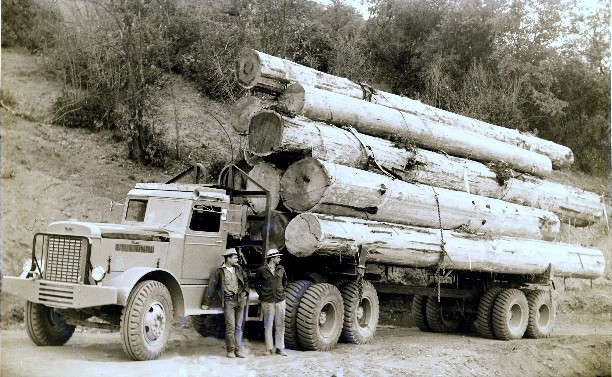
To “protect the security” of the sale, the Deed of Trust further stipulated that Masonite Corporation would build and maintain within two years of the agreement “a high speed, private truck road, between the junction of the North Fork and the Little North Fork of the Navarro River and the City of Ukiah” (Deed of Trust). Masonite Corporation’s ability to pay their promissory notes depended on logging redwood. Southern Pacific ensured that logging would proceed by making construction of Masonite Road a condition of their agreement with Masonite Corporation.
By 1951, just two years after the completion of Masonite Road, Masonite Corporation was “the largest synthetic board plant in the world” with offices in the United States, Canada, Sweden, Italy, South Africa, and Australia (Coates).
Utah Construction Company
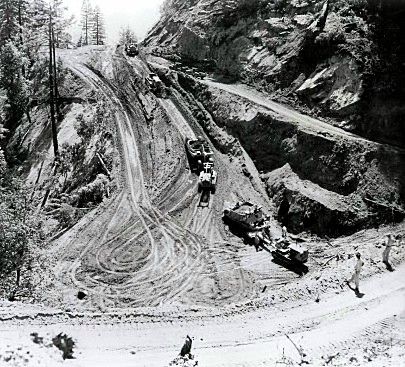
To build their logging road to the coast, Masonite Corporation selected the Utah Construction Company out of the latter’s branch office in San Francisco. Utah Construction was incorporated by three brothers—Edmund Orson Wattis, Jr, Warren L. Wattis and William. H. Wattis—on January 8, 1900.
Their father, Edmund Orson Wattis, had come from England to New Orleans in 1841 as a 13-year old boy aboard the ship Chaos (Sessions 5-6). By 1847, Wattis had joined Mormon pioneers who were building a religious refuge in the Salt Lake Valley of Utah. Two years later he was one of the “goldfield missionaries” collecting tithes for Brigham Young near Sutter’s Fort in California. Eventually he returned to Utah where he married and raised his family. His oldest son and namesake, Edmund, Jr, “dreamed of life beyond the farm” and got his opportunity “when the transcontinental railroad passed virtually through the Wattis front yard” (Sessions 8). A poster boy for hard work, Edmund, at the age of 12, persuaded his parents to let him take an oxen team and help those who were grading the land for the spikers; the job of the spiker was to drive railroad spikes into ties to hold the railroad track in place. As often happens, the boy foreshadowed the man. When Edumnd and two of his brothers founded Utah Construction Company in 1900, their first contracts were for building railroad lines.
Utah Construction Company’s first big contract was to build a railroad line for 942 miles from Salt Lake City to Oakland, California (Sessons 25-6). The line, completed between 1906 and 1911, ran through the High Sierras and the rugged Feather River Canyon, requiring 40 tunnels from 40 to 7500 ft in length. The project employed 7772 men and earned Utah Construction Company $22.3 million (Sessons 25-7). Gene and Sterling Sessions, the chroniclers of Utah Construction, describe the working conditions as rough, with crews living in tents, an occasional harmonica player or fiddler providing the evening entertainment, card games and gambling filling up many of the downtime hours, and “rag saloons” with whiskey and “easy women” sometimes visible a short distance from the camps (Sessions 27-28). Given the size and importance of the project and the constant comings and goings of unfamiliar faces, Utah Construction even resorted, for a time, to very colorful and cryptic language in their business telegrams: “Laconic princess beyond castle. Smash outpost. Dragon inhabits caldron (Sessions 28).
In 1908, Utah Construction completed a job for Southern Pacific Railroad for $2.5 million and in the 1920s followed up with a series of contracts with Southern Pacific amounting to about $20.5 million, including construction of their main line and tunnel through Donner Pass (Sessions 42-3). Utah Construction also owed its first international contract to Southern Pacific, building, in 1923, a 110-mile railroad line in Mexico under primitive conditions that included “furnace-hot temperatures, torrential rains…high humidity…lack of roads…dysentery…malaria…[and] renegade bandits” (Sessions 35-6). In this volatile atmosphere of post-revolution Mexico, Utah Construction even armed its manager with revolvers.
By 1930 Utah Construction had forged its reputation as a railroad builder. As railroad expansion stagnated, the company took on the role of dam builder. In a joint venture with six other companies, Utah Construction built the Hoover Dam in the Black Canyon of the Colorado River. Hoover Dam was begun in 1931 and completed in 1936—3 days short of 5 years. That schedule is even more impressive stacked up against the dam’s statistics: 726.4 ft high, 1244 ft wide, and 660 ft thick at the base. As the largest man-made lake in the US, Lake Mead took 6.5 years to fill up the dammed reservoir, covering 110 miles in length and reaching 589 ft at its deepest point. Between 1936 and 1959, Utah Construction completed 18 other dams including Grand Coulee in Washington.
After their dam-building era, Utah Construction embarked on a series of highway projects, including building the piers and abutments for the east span of the San Francisco-Oakland Bay Bridge. Most notably, between March 8, 1942 and October 25, 1942 the U.S. Army and a group of civilian contractors, led by Utah Construction, completed the 1500-mile Alaskan Highway through vast unmapped arctic wilderness, an engineering feat that, at the time, many considered impossible. Six years later, Utah Construction would begin work on another road in a remnant of northern California wilderness—Masonite Road.
Fast Forward in Time
In 1976, Utah Construction joined with General Electric, the largest corporate merger in U.S. history at that time—over $2 billion.
As of September 11, 1996, the Southern Pacific Railroad was no more. “When the final freight train moving under the railroad’s name arrived at its in destination in San Luis Obispo,” writes Richard Orsi, “the locomotive engineer sent out a parting message over the railroad’s radio network: ‘This is the last sunset for the SP. Good night SP and thanks for the memories’'” (Orsi 407).
Masonite Corporation sold all of its timberland and its “super logging road” to Louisiana-Pacific Corporation on November 6, 1986. A year later Masonite Corporation was bought by International Paper.
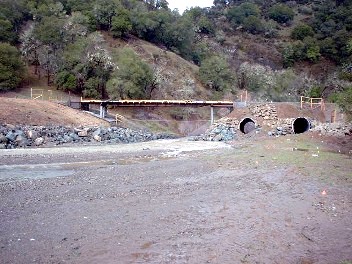
In 1998, Louisiana-Pacific sold its timberlands in Mendocino County, along with Masonite Road, to Mendocino Redwood Company (MRC). MRC tore down the last of the Utah Construction Company sheds, shown in the picture below, in 2006, near the Navarro Boy Scout Camp.
Masonite Road remains a private, gated logging road, whose maintenance and improvement are an ongoing investment for MRC not only in the productivity of a timberland but in the ecological future of a forest.